
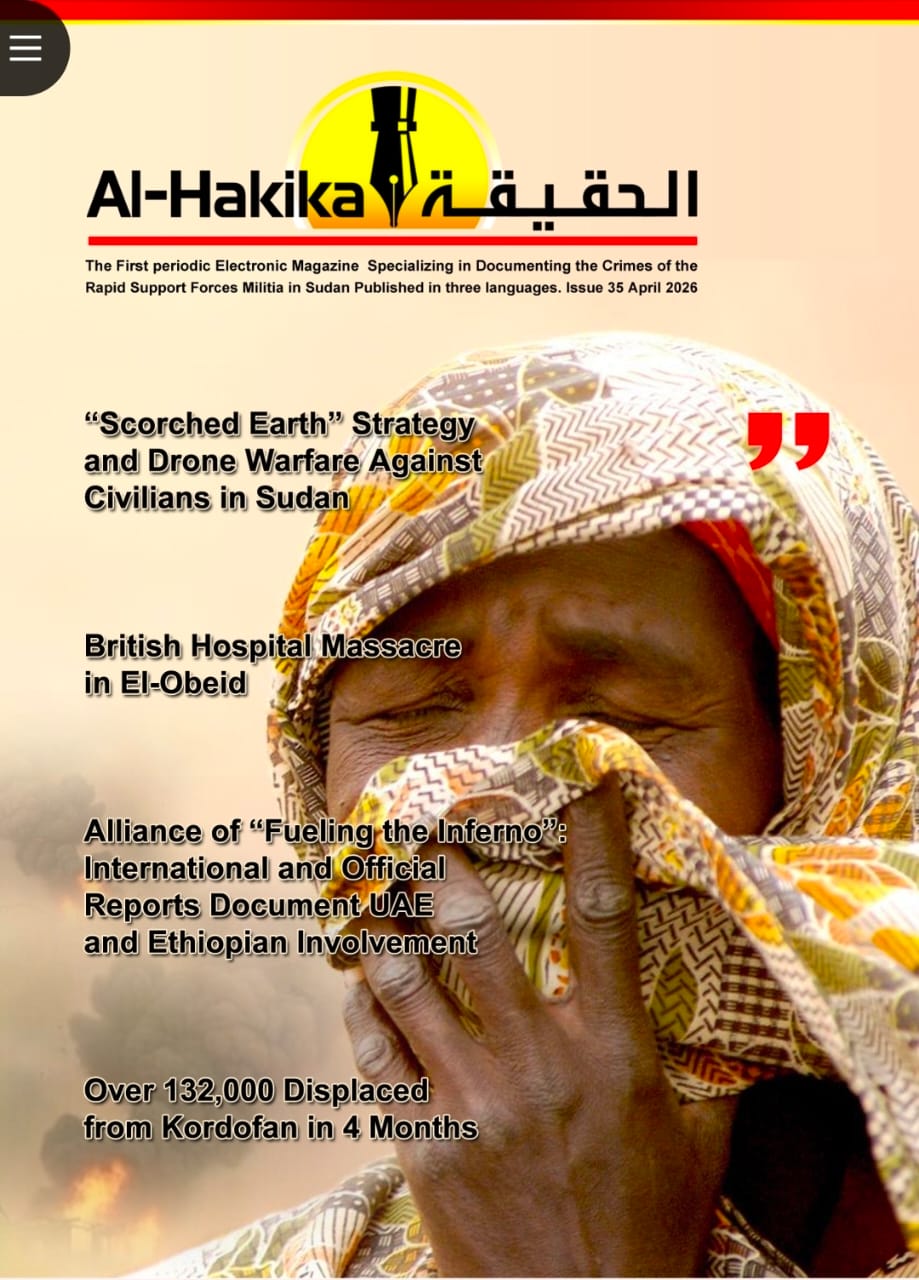
The 35th periodic issue of Al-Hakika Magazine has been released, documenting the crimes of the Rapid Support Forces militia, based on international and local statistics and reports.

Read issue number 35 of Al-Haqiqa magazine, which documents the crimes of the Rapid Support Forces militia according to international and local statistics and reports. This issue focuses on:
▪︎ Fueling the Holocaust: Compelling evidence and international documentation reveal the involvement of the UAE and Ethiopia in the atrocities in Sudan.
▪︎ The Humanitarian Crisis: A UN report confirms the decline of the famine threat immediately after the armed forces broke the siege.
▪︎ The Scorched Earth Strategy: Civilian Targets in the Line of Fire.
▪︎ The Hell of Kordofan: 120 Days of Violations Push 132,000 People into the Unknown.
▪︎ The Weapon of Starvation and the Destruction of Agriculture: US monitoring reveals the erasure of 41 agricultural communities in El Fasher from the productive map.
▪︎ Voluntary Return: “The Will to Survive”: The International Organization for Migration monitors the return of 3.6 million displaced persons and refugees to their homes despite the challenges.
Economy Under the Rubble: Billions of Dollars Evaporate… The Truth Report Documents the Systematic Destruction of the Mining and Industrial Sectors.
▪︎ El Fasher Axis… El Fasher… The Slaughterhouse of the Century: UN Documentation of Ethnic Cleansing and Genocide Led by Militias.
In the Name of God, the Most Gracious, the Most Merciful
Al-Haqiqa (The Truth)
The first periodic electronic magazine specialized in documenting the crimes of the Rapid Support Forces militia, serving as a reference for international organizations and mechanisms concerned with the protection of human rights worldwide. Published in three languages – Issue (35) – April 2026.
⸻
Introduction
In a dangerous escalation reflecting the systematic approach of the rebel Rapid Support Forces militia, the Sudanese Ministry of Foreign Affairs strongly condemned the wave of terrorist attacks targeting civilian objects and vital infrastructure using drone weapons.
These attacks, which recently targeted the cities of El-Obeid, Kosti, and Al-Dilling, are not merely military violations but represent a recurring criminal pattern aimed at terrorizing civilians and undermining the foundations of the Sudanese state.
These attacks constitute full-fledged war crimes and a blatant violation of international humanitarian law and conventions prohibiting the targeting of civilian facilities. The Government of Sudan affirms that the silence of the international community not only emboldens the militia’s sense of impunity but also threatens to undermine the entire international legal system. Sudan has called on the United Nations and the Security Council to move beyond mere statements of condemnation and take concrete measures to hold the militia and its supporters accountable, including those providing financial or logistical support.
Meanwhile, the United Nations Fact-Finding Mission issued a devastating report condemning atrocities committed by the militia in El Fasher, North Darfur. The report concluded that the patterns of behavior and demonstrated intent provide strong legal indicators of genocide, rising to the level of crimes against humanity.
Human Rights Watch also documented deliberate killings and mistreatment targeting persons with disabilities in El Fasher, urging the international community to break its silence regarding continued Emirati support for the militia, which fuels the killing machine in Sudan.
This issue of Al-Haqiqa highlights, through field reports and precise statistics, the following topics:
• External intervention: Evidence documenting the involvement of the UAE and Ethiopia in fueling the conflict and supplying the militia with destructive means.
• Drone warfare: Monitoring the militia’s strategy of targeting civilian objects, gatherings, medical personnel, and hospitals.
• Displacement crisis: Detailed statistics on major waves of displacement from Kordofan due to escalating violations.
It also highlights international reports confirming a decline in famine risk in South Kordofan following the Sudanese army’s success in lifting the siege on Kadugli, allowing thousands of displaced persons and refugees to return home and enabling the flow of vital aid.
⸻
Al-Haqiqa Documents
Civilian Objects Under Fire: “Scorched Earth” Strategy and Drone Warfare Against Civilians in Sudan
March 2026
In a dangerous and systematic escalation, the Rapid Support Forces militia launched widespread attacks using drones, targeting civilian areas in North Kordofan and White Nile states. These actions directly strike at the lifelines of Sudanese citizens, going beyond military operations to constitute complete war crimes aimed at destroying the basic means of survival.
Targeting Educational Institutions and Student Housing
The militia committed a massacre at “Shukairi” School in White Nile State, where 17 civilians, including students and teachers, were killed in a direct attack on a school and village devoid of any military presence.
Student dormitories in Kosti and El-Obeid were also targeted, resulting in injuries and destruction of educational facilities, including electronic libraries and reading halls—clearly aiming to disrupt education and terrorize future generations.
Destruction of the Health System
At a time when Sudanese suffer from severe shortages of medicine, the militia bombed the Kordofan Oncology Center, the Medical Supplies Headquarters, and the British Hospital, threatening the lives of thousands of cancer patients and critical cases.
Targeting Infrastructure
Drone attacks also targeted power substations in El-Obeid and Rabak, causing complete blackouts and cutting electricity to hospitals and homes.
Undermining Food and Economic Security
The militia targeted the Shambali Oil Factory and the industrial area in El-Obeid, dealing a severe blow to local economic stability and food security.
These acts occur amid shameful international silence regarding the use of suicide drones against schools, hospitals, and power stations.
⸻
Al-Haqiqa Documents
Alliance of “Fueling the Inferno”: International and Official Reports Document UAE and Ethiopian Involvement
Recent developments and international reports reveal dangerous dimensions of regional involvement in Sudan’s conflict, pointing clearly to direct and ongoing involvement by the United Arab Emirates and Ethiopia in supporting military operations targeting civilians and national sovereignty.
According to UN fact-finding reports (2026) and Human Rights Watch:
• Enabling atrocities: Continued Emirati military support has been a key driver of war crimes and crimes against humanity in El Fasher and across Darfur.
• Evidence includes patterns of killing, rape, and forced displacement indicating genocidal intent.
• Accountability demands: Rights groups have called on the UN Security Council to investigate UAE involvement and impose a comprehensive arms embargo on Sudan.
Ethiopia: A Direct Violation of Sovereignty
Sudan’s Ministry of Foreign Affairs accused Ethiopia of shifting from alleged neutrality to direct aggression, citing drones entering from Ethiopian territory to strike inside Sudan.
Sudan described this as a blatant violation of sovereignty and affirmed its right to defend its territory.
⸻
Al-Haqiqa Documents
El Fasher Under the Guillotine of Genocide: UN Report Documents “Ethnic Eradication”
A 2026 UN investigation revealed shocking findings, concluding that what non-Arab groups—particularly the Zaghawa and Fur—faced amounts to genocide.
• Evidence of intent: Attacks were systematic and driven by genocidal intent.
• Sexual violence: Rape was used as a coordinated weapon to destroy communities.
• Starvation and siege: An 18-month siege weakened civilians before attacks.
The mission head confirmed these crimes were organized and supported by senior militia leaders.
⸻
Al-Haqiqa Documents
Evidence of Engineered Famine: Yale Lab Reports Destruction of 41 Agricultural Communities
(March 10, 2026)
Yale University researchers found that at least 41 rural agricultural communities around El Fasher were deliberately destroyed between March and June 2024.
Key findings:
• 68% show no visible life
• 12% show minimal activity
• 20% show near-normal activity
Satellite data indicates widespread fires, destruction of infrastructure, and a 330% increase in fire indicators in 2024.
Agricultural activity dropped sharply:
• 80% of villages saw major decline
• Cultivated land decreased by 82%
These findings suggest forced displacement or killing of residents and increased famine risk.
⸻
Al-Haqiqa Documents
British Hospital Massacre in El-Obeid
(March 2026)
Sudan Doctors Network reported a militia attack on the British Hospital in El-Obeid, injuring 12 people, including 5 medical staff.
The attack was condemned as:
• A grave violation of international humanitarian law
• A direct assault on civilian infrastructure
Additional incidents included:
• Killing of 28 civilians in North Darfur
• Artillery attacks in Al-Dilling causing deaths and injuries
⸻
Al-Haqiqa Documents
Over 132,000 Displaced from Kordofan in 4 Months
(March 12, 2026)
Data from the International Organization for Migration shows:
• 132,693 displaced persons
• Spread across 678 locations in 79 localities
Main affected states:
• North Kordofan
• Khartoum
• White Nile
• South Kordofan
⸻
Al-Haqiqa Documents
UN Report: Famine Risk Declines in Kadugli After Siege Lifted
(March 11, 2026)
Following the lifting of the siege:
• Aid deliveries resumed
• Food prices dropped significantly
• 700 metric tons of aid reached 70,000 people
The UN confirmed aid convoys reached over 130,000 people in Kadugli and Al-Dilling.
⸻
Al-Haqiqa Documents
3.6 Million Displaced Sudanese Return Home
The International Organization for Migration reported:
• 3.6 million returnees
• 21% reduction in displacement
Main returns:
• Khartoum (44%)
• Al-Jazirah
• Sennar
Reasons for return:
• 89% improved security
• 8% lack of resources in displacement areas.
