
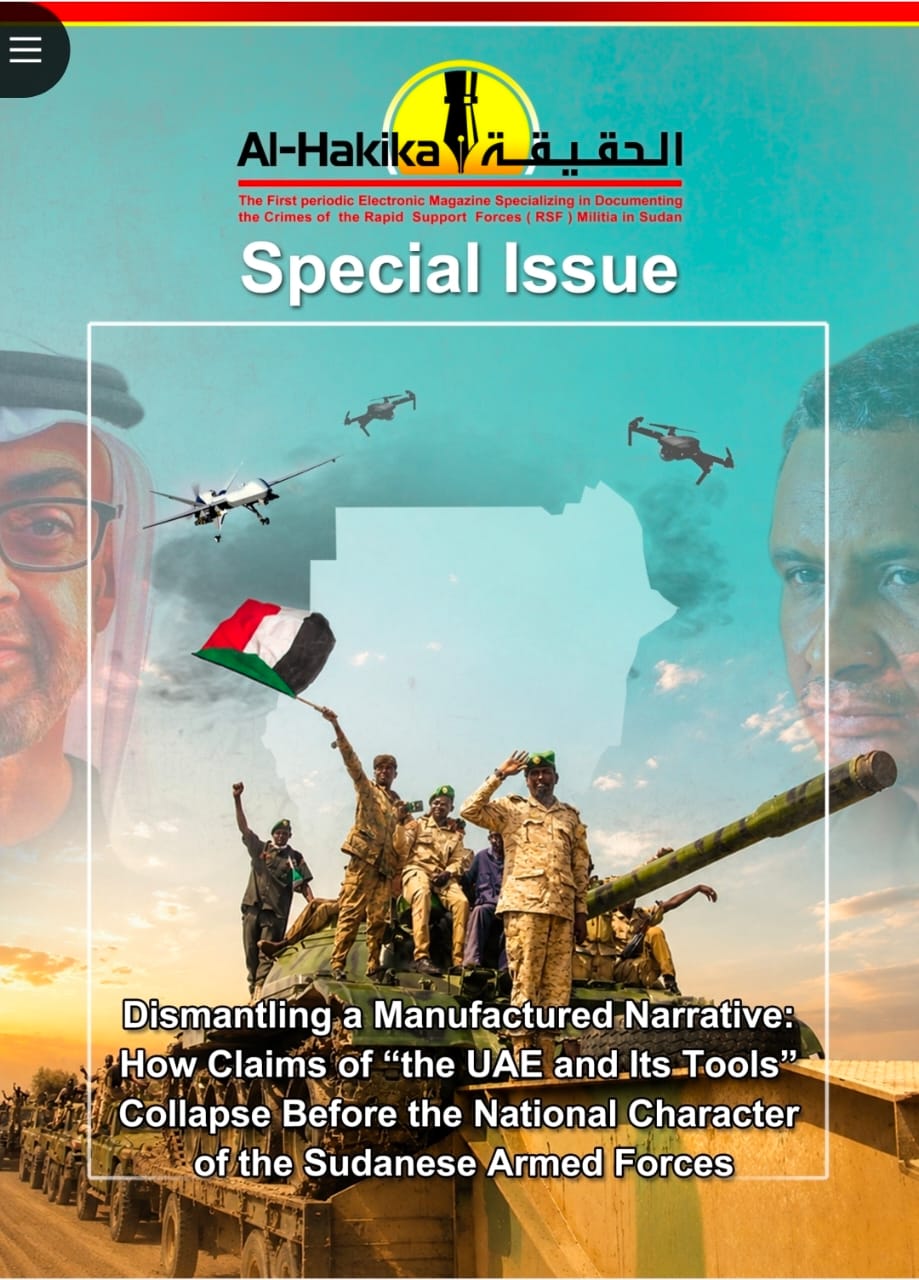
Dismantling a Manufactured Narrative: How Claims of “the UAE and Its Tools” Collapse Before the National Character of the Sudanese Armed Forces؟

In the Name of Allah, the Most Gracious, the Most Merciful
Al Hakika
The first specialised periodic electronic magazine dedicated to documenting the crimes of the terrorist Rapid Support Forces militia. Published in three languages, it serves as a reference for mechanisms concerned with the protection of human rights worldwide.
Special Issue
Dismantling a Manufactured Narrative: How Claims of “the UAE and Its Tools” Collapse Before the National Character of the Sudanese Armed Forces
Introduction
The political and media landscape surrounding the Sudanese crisis is witnessing an intensive flow of directed narratives led by media rooms affiliated with the United Arab Emirates and adopted by regional platforms such as Sky News Arabia, in full alignment with the political and military discourse of the Rapid Support Forces militia and its political ally, Taqaddum.
This narrative revolves around one central axis: an attempt to associate the Sudanese Armed Forces with the Islamic Movement or the Muslim Brotherhood. This analytical reading seeks to dismantle these claims by refuting their political motives and comparing them with the structural composition and historic military doctrine of the Sudanese Armed Forces as a comprehensive national institution.
First: Strategic Motives Behind the “Ideologisation” Falsehood
The insistence on branding the Sudanese Armed Forces as “ideologised” or partisan is not merely an inaccurate journalistic description. Rather, it is a calculated political strategy that serves specific objectives for the UAE, the militia and its political ally, including the following:
▪︎ Stripping away moral and legal legitimacy: This discourse seeks to portray the war in Sudan as a “conflict between forces of democratic transition and groups of religious extremism”, rather than its true nature as “an armed rebellion by a family-based militia against the official institution of the state”.
▪︎ Soliciting international and Western sympathy: Disinformation rooms recognise that terms such as “Muslim Brotherhood” and “political Islam” are effective tools for stirring concern among Western capitals and the international community, thereby obstructing any diplomatic or military support for the legitimate Sudanese Government.
▪︎ Providing political cover for the militia: This false linkage gives the Rapid Support Forces militia and its supporting political alliance a moral pretext before domestic and international public opinion to continue the war and violations under the banner of “confronting remnants of the former regime”.
Second: Structural Composition of the Sudanese Army: Diversity of Features and Tribes
The falsehood of “ideologisation” collapses immediately upon examining the organic and social structure of the Sudanese Armed Forces, which is distinguished by two main characteristics:
- National character and broad representation
The Sudanese Armed Forces, formerly the Sudan Defence Force, were established nearly a century ago on the doctrine of belonging to the national soil, not to ideology. They remain the only institution that represents a “miniature Sudan”, with their ranks comprising:
Complete ethnic and tribal diversity: From the Blue Nile to Darfur, and from the Nuba Mountains to eastern and northern Sudan, all Sudanese features merge within this institution into one unified identity, namely the “Sudanese military identity”.
Strict professional hierarchy: Advancement within the military ranks is governed by military service regulations, years of seniority, field competence and academic attainment at the Military College and the Command and Staff College, not by organisational or political loyalty.
- Absence of partisan ideologisation in combat doctrine
Throughout its modern history, the Sudanese Army has fought multiple battles to protect the entity of the state against various rebel movements. The doctrine driving these battles has never been based on partisan or religious literature. Rather, it has always centred on safeguarding national security and the territorial integrity of the country. The claim that the army is ideologised because of a particular period of rule ignores the fact that political regimes change, while the institutional doctrine of the army remains constant and continuous.
Third: Contradictions in the Discourse of “UAE Media Rooms” and the Militia’s Allies
The fragility of the narrative promoted by Sky News Arabia and the digital rooms of Dubai and Abu Dhabi is exposed through a set of stark contradictions, including the following:
▪︎ The accusation that the army is ideologised emerges from a remarkable paradox. This accusation is led by a militia that lacks the most basic standards of national institutionality, and is supported by a political ally that overlooks the systematic violations and ethnic cleansing committed by the militia in Darfur and Al Jazirah, while focusing solely on marketing the scarecrow of the “Muslim Brotherhood”.
Fourth: Popular Mobilisation and Community Resistance: The Narrative’s Collapse
Perhaps the strongest practical evidence refuting the claims of UAE media is the nature of the popular resistance and broad mobilisation witnessed across Sudan’s states after the outbreak of the war.
The millions who responded to the call of the Sudanese Armed Forces did not act from partisan motives. They came forward to defend their honour, their homes and the institutions of their state, all of which had been subjected to unprecedented barbaric violations by the militia.
This sweeping popular rallying, which includes Sufi orders, native administrations, political forces from the far right to the far left, and independent citizens, proves that Sudanese society views the army as the country’s only national safety valve, not as a façade for any specific political current.
Fifth: Collapse of Media Professionalism Across the Axis Platforms: Sky News as a Case Study
Sky News Arabia has fallen into repeated professional lapses that revealed a complete absence of neutrality and objectivity, transforming it into a platform for psychological warfare and systematic disinformation through the following:
▪︎ Fabricating clips and visuals.
▪︎ Using old footage, or footage from other countries, and attributing it to the Sudanese reality to suggest that “extremist groups” are fighting alongside the army.
▪︎ Overlooking documented violations.
▪︎ Ignoring United Nations and international reports, including those by Human Rights Watch and UN experts, which condemn the UAE for financing the militia, while focusing instead on manufacturing narratives of ideologisation.
Conclusion
The attempts by UAE media rooms, Sky News Arabia, the Rapid Support Forces militia and its political ally to associate the Sudanese Armed Forces with the Muslim Brotherhood constitute a political propaganda operation that lacks structural and factual basis.
The Sudanese Army, with its social fabric extending across all tribes and features of the country, and with its long professional legacy, remains a national state institution that resists stereotyping and political blackmail. The collective awareness of the Sudanese people, and their current cohesion with their armed forces, form the rock upon which strategies of demonisation and the falsification of regional and international awareness continue to break.
