
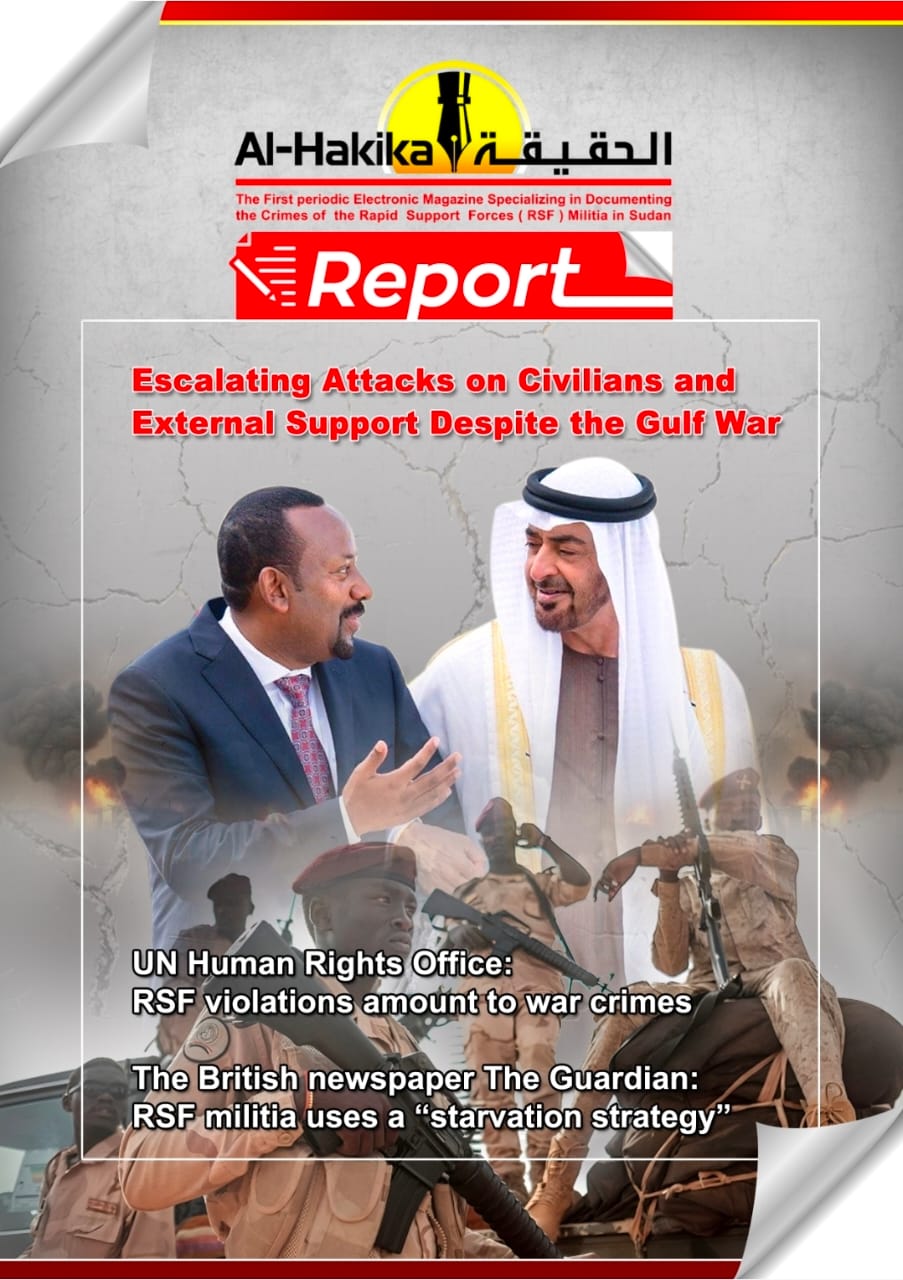
Al-Hakika report: Militias escalate their targeting of civilians, and UAE support continues despite the Gulf War

Al-Hakika report: Militias escalate their targeting of civilians, and UAE support continues despite the Gulf War
Al-Haqiqa (The Truth)
The first periodic electronic journal specializing in documenting the crimes of the Rapid Support Forces militia, serving as a reference for international human rights organizations and mechanisms.
Report: Escalating Attacks on Civilians and External Support Despite the Gulf War
⸻
Key Points
▪ The Rapid Support Forces (RSF) militia has continued targeting civilian objects in Kordofan, Darfur, and White Nile states
▪ A United Nations report: RSF forces carried out mass killings, executions, sexual violence, and kidnappings for ransom
▪ UN Human Rights Office: RSF violations amount to war crimes
▪ Volker Türk: Deliberate violations by RSF confirm that ongoing impunity fuels cycles of violence
▪ UN report: RSF committed acts amounting to war crimes, including killing, deliberate attacks on civilians and civilian objects, and the use of starvation as a method of warfare
▪ The British newspaper The Guardian: RSF militia uses a “starvation strategy”
⸻
Introduction
Violations by the rebel Rapid Support Forces militia against civilians have not ceased for a single day since the outbreak of war on April 15. The number of victims continues to rise steadily, amid ongoing flows of support from the United Arab Emirates through various routes, including the southeastern front of Sudan.
Attacks have intensified from land, air, and across Ethiopian borders. Evidence suggests that Emirati support for the militia continues despite the ongoing Gulf war and the suspension of most airport operations in the UAE due to the conflict.
Crimes against civilians have expanded from hospitals to schools and other civilian infrastructure, including markets, shops, and service facilities. One of the most prominent incidents is the Shukairi school tragedy in White Nile State. A final death toll remains unavailable due to continued attacks across Darfur, Kordofan, and the Blue Nile region.
⸻
International Reactions
International condemnation has continued from major organizations, particularly the United Nations.
The UN High Commissioner for Human Rights, Volker Türk, condemned the targeting of White Nile State by waves of drones belonging to the RSF militia.
In a strongly worded statement, he warned that the escalating pace of attacks since early March is pushing the region toward a new humanitarian crisis, with fears of expanding violations.
⸻
Shukairi Village Attack
Local reports and eyewitnesses confirmed a drone strike targeting the village of Shukairi, northwest of Al-Duweim in White Nile State, resulting in more than 20 civilian deaths and multiple injuries.
Field data indicate that the attack struck vital civilian facilities, including:
• A basic education school
• A health center serving local and surrounding rural populations
This caused significant human losses and severe destruction of civilian infrastructure.
Shukairi is classified as a purely civilian area with no military presence, raising serious questions about the motives behind targeting protected civilian objects under international humanitarian law.
The nature of the attack suggests possible retaliatory motives against residents who opposed militia presence and clashed with affiliated groups.
⸻
Calls for Documentation
Calls are increasing to document violations against:
• Health facilities
• Educational institutions
There is strong emphasis on protecting civilians and service institutions from armed conflict in accordance with international conventions.
⸻
Continued UAE Support Despite the Gulf War
Attacks on civilians using advanced weaponry continue alongside ongoing Emirati support for the RSF.
According to Le Monde Afrique, while thousands of commercial flights from Abu Dhabi and Dubai were canceled due to Iranian strikes, cargo planes supplying RSF forces with weapons and military equipment continued operating.
The article notes that:
• Air transport halted for only four days
• Flights resumed gradually from March 3
• Large cargo aircraft resumed routes to Africa
It also reports that:
• The American consulate in Dubai was targeted by Iranian drones
• Despite disruptions, military supply routes remained active
The newspaper emphasized that UAE influence has been prominent since the outbreak of war in Sudan in April 2023.
It stated that RSF receives full support from the UAE, supplying Mohamed Hamdan Dagalo (“Hemedti”) with:
• Weapons and ammunition
• Vehicles
• Drones
• Mercenaries
This requires a complex air logistics network extending from Abu Dhabi to Darfur.
⸻
Attacks on El-Obeid Industrial Area
In late February, RSF drones targeted the industrial zone in El-Obeid, North Kordofan, in a new attack on civilian infrastructure and livelihoods.
The attack affected:
• Commercial shops
• Warehouses
Local authorities described it as another crime added to the militia’s record of violations against civilians and economic resources.
⸻
Damage to the University of Kordofan
The University of Kordofan in El-Obeid suffered severe damage due to RSF drone strikes.
The university stated:
“In one of the most heinous crimes, the university was targeted by drone attacks affecting its central campus facilities.”
Emergency Lawyers also condemned the attack, stating it violates international humanitarian law, which protects educational institutions.
They described the strike as:
• A direct attack on the right to education
• A threat to students’ future
⸻
Use of Starvation as a Weapon
An investigation by The Guardian revealed that RSF employed a “starvation strategy” by targeting agricultural fields in Darfur using drones.
Satellite imagery shows systematic attacks on farms in North Darfur.
Experts confirmed that:
• The attacks aimed to prevent food production
• 41 farming communities were targeted between March and June 2024
The strategy was reportedly designed to destroy local food supply chains before the siege of El Fasher.
By September 2024:
• Villages were abandoned
• Agriculture had completely ceased
Legal experts argue these actions constitute war crimes by using starvation as a weapon.
⸻
UN Human Rights Report
A report by the UN Human Rights Office documented extreme violence during the RSF assault on El Fasher in October.
Key findings include:
• Over 6,000 deaths in the first three days
• At least 4,400 killed the city
• More than 1,600 killed while fleeing
The report documented:
• Mass killings
• Summary executions
• Sexual violence
• Kidnappings for ransom
• Torture and enforced disappearances
• Looting
• Recruitment of children
Many attacks targeted civilians based on ethnic identity.
⸻
Impunity
Volker Türk stated:
“The deliberate violations committed by RSF confirm that ongoing impunity fuels cycles of violence.”
He called for:
• Independent investigations
• Criminal accountability, including senior leadership
⸻
Legal Classification
The report concludes there are reasonable grounds to believe RSF committed war crimes, including:
• Killing civilians
• Deliberate and indiscriminate attacks
• Starvation as a method of warfare
• Attacks on humanitarian and medical workers
• Sexual violence and torture
• Looting and child recruitment
⸻
Call to Action
The UN High Commissioner stressed that the unprecedented scale and brutality of violence in El Fasher has worsened an already catastrophic humanitarian situation.
He also noted testimonies from survivors confirming the systematic use of sexual violence as a weapon of war
