
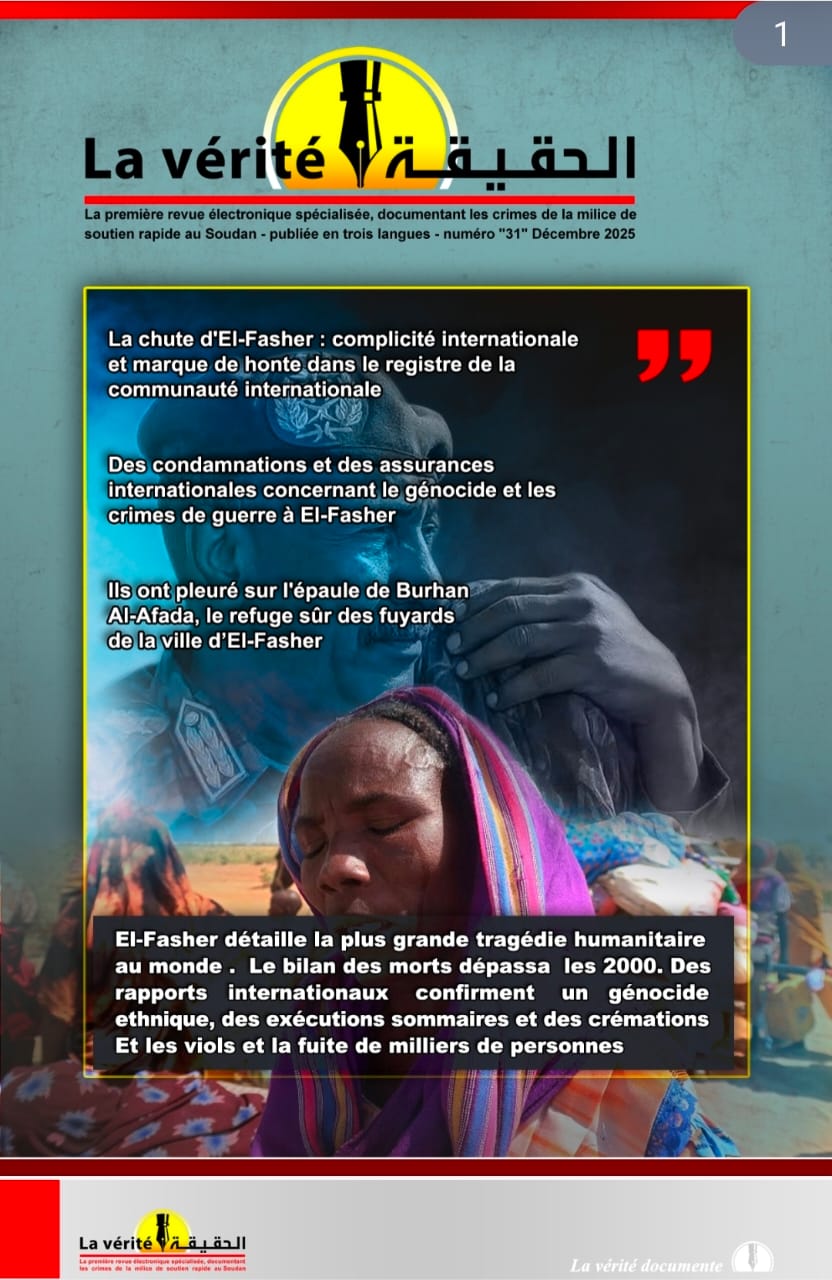
The fall of El Fasher was an international conspiracy and a stain on the record of the international community

In the name of God, the Most Gracious, the Most Merciful
Al-Hakika (The Truth)
The first periodical electronic journal specializing in documenting the crimes of the Rapid Support Forces militia in Sudan, serving as a reference for international organizations and mechanisms concerned with protecting human rights worldwide – Issue 31 – December 2025
Introduction
The Sudanese Ministry of Foreign Affairs and International Cooperation welcomed the statements of US Secretary of State Marco Rubio regarding the situation in Sudan.
Minister of Foreign Affairs and International Cooperation, Ambassador Mohi El-Din Salem, stated to the Sudan News Agency that calling things by their proper names and directly accusing the terrorist militia and the mercenaries it employed of committing massacres against innocent civilians, and the possibility of designating it as a terrorist organization, paves the way for correcting the international community’s perspective on what is happening in Sudan. It also distances the international community from equating the regular national army (SAF) with an outlawed tribal militia. He added that the US Secretary of State’s statements, acknowledging the brutality of the terrorist militia’s practices and the necessity of confronting them and halting the flow of weapons, send a strong message to the other countries involved in the Sudanese peace process and those that support the militia, either by supplying them with weapons or allowing them to use their territories and borders to smuggle weapons and mercenaries.
The minister stated that it is too late to stop the bloodshed of the Sudanese people. The international community’s delayed response to the Sudanese government’s repeated appeals to compel the militia to implement UN Security Council resolutions, such as Resolution 2736/2024, to allow aid into El Fasher, has led to the humanitarian catastrophe we are witnessing in El Fasher. The international community has been warned that the militia is employing the same tactics, besieging the cities of Dilling, Kadugli, and Babanusa. This situation demands immediate attention from the international community to prevent a repeat of the tragedy in El Fasher.
US Secretary of State Marco Rubio accused the Rapid Support Forces (RSF) of being the “core problem” in the ongoing conflict in Sudan. He noted that the RSF agrees to agreements but never adheres to them, nor is it capable of implementing them, leading to a genuine catastrophe on the ground.
Rubio’s remarks came during a press briefing he gave upon leaving the G7 foreign ministers’ meeting in Canada. He called for urgent international action to halt the flow of weapons and support to the militia, which continues its systematic violations.
Rubio stated, “Some countries are supplying weapons to parties in the Sudanese conflict, and this must stop immediately.” He affirmed that the United States is exerting pressure on countries supporting the RSF to cease arming them, warning that the continuation of this support will only exacerbate the bloodshed. The US Secretary of State indicated that the Rapid Support Forces (RSF) militia is implicated in committing atrocities against civilians, including the rape of women, describing these violations as systematic, not isolated acts by rogue elements. He added, “If designating the RSF as a terrorist organization will help resolve this, so be it.”
He called on the international community to take decisive steps to end external support for the RSF militia, warning of a worsening humanitarian crisis in Sudan.
In his address to the Human Rights Council on November 14, 2025, UN High Commissioner for Human Rights Volker Türk said that the atrocities unfolding in El Fasher “were foreseeable and preventable—but they were not prevented,” adding that they constitute “the most serious crimes.” The High Commissioner said his office had issued repeated warnings about the situation in the capital of North Darfur over the past year, “so none of us should be surprised by reports that since the RSF took control of El Fasher, there have been mass killings of civilians and targeted tribal executions.” Sexual violence, including gang rape; kidnapping for ransom; widespread arbitrary arrests; attacks on health facilities, medical personnel, and humanitarian workers; and other horrific atrocities.
The United Nations, international mechanisms, and several countries condemned the atrocities committed against civilians in El Fasher, North Darfur, and Bara, North Kordofan. The 31st issue of Al-Hakika (The Truth) sheds light on the tragedy in El Fasher, North Darfur, and the atrocities in Bara, North Kordofan, in a special report supported by figures, statistics, international and local reports and investigations, and testimonies from victims and witnesses.
The Truth Documents
Hundreds Killed, Extrajudicial Killings in Hospitals, and Rapes… Rapid Support Forces Militia Violations Force Thousands to Flee Bara in North Kordofan
On October 31, 2025, the Sudanese Doctors Network reported that 4,500 people had been displaced from the city of Bara in North Kordofan due to deteriorating security and the ongoing violations committed by the Rapid Support Forces militia against civilians.
The Sudanese Doctors Network confirmed that the Rapid Support Forces militia caused the displacement of more than 4,500 citizens from Bara. Approximately 1,900 of them have reached the city of El Obeid, while the rest are still on their way amidst harsh conditions and severe shortages of food, water, and shelter.
Field reports from the Sudanese Doctors Network teams indicated that the majority of displaced families arrived in a state of extreme exhaustion, and numerous cases of diarrhea and malnutrition were recorded, particularly among children and the elderly.
The Sudanese Doctors Network reported that health facilities in El Obeid are facing increasing pressure beyond their operational capacity due to severe shortages of medicines, medical supplies, and personnel.
The Network condemned the forced displacement of unarmed civilians by the Rapid Support Forces (RSF) militia in Bara and expressed its deep concern over the deteriorating humanitarian situation.
The Network called on humanitarian organizations and local authorities to intervene urgently to provide basic necessities for the displaced.
Rapid Support Forces Militia Commits Brutal Massacres in Bara: Hundreds Killed, Reports of Systematic Torture and Armed Looting
Local sources reported that the Rapid Support Forces (RSF) militia committed horrific massacres against civilians in Bara, where hundreds were killed in violent attacks that included systematic torture, widespread armed looting, and the enforced disappearance of dozens of victims.
The RSF militia stormed the city on October 27, 2025, and swept through residential neighborhoods, targeting unarmed civilians indiscriminately, regardless of age or gender. Sources confirmed that the death toll exceeded 300 people in a single day, most of them women, children, and the elderly, while many bodies remain lying in the streets due to the denial of humanitarian access.
The violations included systematic torture. Survivors recounted how dozens of people were detained in makeshift centers and subjected to beatings, burns, and electric shocks to extract information or spread terror.
The militia also carried out armed looting of homes and markets, resulting in the destruction of public and private property.
They stole livestock and agricultural crops, on which the region’s livelihood depends.
In a related context, families reported the enforced disappearance of more than 50 people, with no trace or contact with them.
On November 1, 2025, the Sudanese Doctors Network revealed that the Rapid Support Forces militia committed a massacre at the medical hospital in Bara, North Kordofan State, carrying out the execution of all doctors in the obstetrics and gynecology department, as well as pregnant women, children, and other patients present in the hospital.
Meanwhile, the Rapid Support Forces militia and the Popular Movement militia, led by Abdel Aziz al-Hilu, targeted the Kalba camp for displaced people in Kadugli, South Kordofan State, with a drone, resulting in the martyrdom of 7 civilians, including 6 from one family, and the injury of 7 others.
Names of the Martyrs:
- Martyr Adam Abdel Rahim Mohamed
- Martyr Fatima Mohamed Ahmed
- Martyr Rehab Adam Abdel Rahim
- Martyr Mohamed Adam Abdel Rahim
- Martyr Sarah Adam Abdel Rahim
- Martyr Amina Adam Abdel Rahim
- Martyr Ahmed Abdullah Mohamed (a member of the Armed Forces who was martyred while attempting to rescue the family).
Names of the Wounded:
- Child Abdel Rahim Ahmed Abdullah
- Awad Al-Karim Al-Hassan Mohamed
- Al-Taya Mohamed Abdullah
- Nasr Al-Din Abdel Rahman Adam
- Faiza Abdullah Rahma
- Manahil Abdullah Adam
- Maryam Rahma Abdel Karim
The governor of South Kordofan State, Mohamed Ibrahim Abdel Karim, strongly condemned the attack, asserting that it added to the dark record of the Sudan People’s Liberation Movement-Rapid Support Forces (SPLM-N) alliance. In his statement to Al-Karama newspaper, the governor said that targeting camps for internally displaced persons (IDPs) constitutes a heinous crime and a flagrant violation of all humanitarian norms and laws. He explained that the drone carried out two successive attacks on the camp, which is located within the International Organization for Migration (IOM) compound, and that all the victims were women and children.
On November 6, 2025, Adiba Ibrahim Al-Sayed, an internal medicine and epidemiology specialist and a member of the Omdurman branch of the preparatory committee, revealed to Sudan Tribune that “11 women were raped by Rapid Support Forces militia members in Bara.”
She indicated that the women who were raped were transferred to Al-Ubayyid Hospital for treatment.
The Sudanese Ministry of Health announced the killing of 12 medical personnel in Bara by Rapid Support Forces militia gunfire, while the Emergency Lawyers group reported that the forces’ violations in the area included mass killings, arrest campaigns, looting, and vandalism.
The Truth Documents
El Fasher: Details of the World’s Largest Humanitarian Tragedy… Death Toll Exceeds 2,000… International Reports Confirm Genocide on Ethnic Grounds, Summary Executions, Burning of Corpses, Rape, and the Flight of Thousands
On October 27, 2025, the Humanitarian Research Laboratory (HRL) at the Yale School of Public Health found evidence from satellite imagery and open-source data consistent with mass killings carried out by the Rapid Support Forces (RSF) militia after they seized control of El Fasher in North Darfur.
According to the Yale lab’s analysis, militia vehicles were observed in combat formations conducting successive house-to-house searches in a first-class neighborhood, an area where civilians had sought refuge.
Satellite images revealed bodies and discoloration in the ground near militia vehicles and within 250 meters of the Al-Safiya Mosque, which was targeted by a Janjaweed drone strike last September, resulting in the deaths of approximately 78 people.
The images also showed bodies near the earthen berm surrounding El Fasher, consistent with reports of executions and the killing of civilians attempting to flee the city. These findings are consistent with several credible reports of mass killings that have circulated on social media and open-source media.
Satellite imagery also indicated large groups of people leaving the city, heading south toward the militia-controlled Zamzam camp for internally displaced persons and west toward Tawila, confirming reports of civilians fleeing El Fasher in recent hours.
Human remains were visible along the road leading to Zamzam, formerly one of the largest camps for internally displaced persons in Sudan and now a militia operations base. Yale Lab also identified groups of people moving west toward the berm surrounding the city.
Sudan Doctors Network: Rapid Support Forces Collect and Burn Bodies
The Sudan Doctors Network stated that the Rapid Support Forces militia collected hundreds of bodies from the streets and neighborhoods of El Fasher, then buried some in mass graves and burned others completely in a desperate attempt to conceal their crimes against civilians. This latest crime adds to the Rapid Support Forces’ record and represents one of their most heinous and inhumane practices.
The network considers what happened in El Fasher not an isolated incident, but a new chapter in a full-fledged genocide perpetrated by the Rapid Support Forces militia, blatantly disregarding all international and religious norms that prohibit mutilating corpses and guarantee the deceased the right to a dignified burial.
The Sudanese Doctors Network strongly condemned these horrific crimes, holding the militia leadership fully responsible for these massacres. They emphasized that these crimes will not be erased by cover-ups or arson and called on the international community to take immediate and urgent action to launch an independent international investigation into what is happening in El Fasher. The situation in El Fasher has transcended the bounds of a humanitarian catastrophe and constitutes a systematic genocide targeting human life and dignity, amidst a shameful international silence that amounts to complicity.
Minister of Social Welfare: Militia Killed 300 Women in Just 48 Hours
Meanwhile, Sudan’s Minister of State for Social Welfare, Salma Ishaq, stated that the Rapid Support Forces militia killed 300 women within the first two days of entering El Fasher, the capital of North Darfur State in western Sudan. She indicated that the women were subjected to sexual assault, violence, and torture.
On October 26, the militia stormed El Fasher, committing massacres against civilians, according to local and international organizations, amid warnings of a further geographical division of the country.
Ishaq noted that “anyone leaving El Fasher for Tawila (in North Darfur) is in danger” because the road between them “has become a road of death.”
She continued, “There are families still in El Fasher who are vulnerable to being dragged through the streets, tortured, abused, humiliated, and subjected to sexual violence.”
She emphasized that “what happened in El Fasher is systematic ethnic cleansing and a major crime in which everyone is complicit through their silence.”
Earlier, Sudan briefed the UN High Commissioner for Human Rights and several international organizations in Geneva on the “horrific atrocities and violations” committed by the Rapid Support Forces (RSF) in El Fasher.
150 Women Raped and Harassed During Their Displacement from El Fasher
On November 7, 2025, Adam Rijal, spokesperson for the General Coordination of IDP and Refugee Camps in Darfur, stated that more than 150 women were raped and sexually harassed while fleeing El Fasher to Tawila, a town 60 kilometers west of El Fasher.
The RSF militia is pursuing those fleeing El Fasher on the roads, having rounded some up in the Qarni area, where thousands remain stranded, including children separated from their families.
Eyewitnesses told Sudan Tribune that more than 1,300 people have been wounded by gunfire, while over 1,210 children are suffering from malnutrition, and 700 elderly people are in critical condition.
The General Coordination of IDP and Refugee Camps is a civil society organization that monitors violations against internally displaced persons (IDPs) and refugees.
A spokesperson for the Coordination confirmed that more than 15,000 survivors from El Fasher have arrived in the Tawila area, some of whom are suffering from poor health due to injuries and violence.
The spokesperson called on international and humanitarian organizations to provide life-saving medicines, food, safe water sources, shelter materials, and latrines, in addition to psychological support and safe spaces for children traumatized by the horrific scenes they witnessed during their journey.
The spokesperson noted that the Tawila area, which has received hundreds of IDPs in recent months, is now hosting more than one million IDPs, requiring additional support to meet their basic needs. The Federal Ministry of Health expresses its deep sorrow and condemnation regarding the massacre at the Saudi Maternity Hospital in El Fasher.
The Federal Ministry of Health expressed its profound sorrow over the horrific crime committed at the Saudi Hospital in El Fasher, which claimed the lives of more than 460 innocent civilian patients and their companions.
The Federal Minister of Health, Professor Haitham Mohamed Ibrahim, stated that these brutal attacks on health facilities and medical personnel constitute a flagrant violation of all international conventions, particularly international humanitarian law, and represent crimes against humanity that cannot be overlooked.
Doctors kidnapped in El Fasher; ransom demanded exceeding $250,000.
The Sudanese Doctors Network reported that the Rapid Support Forces (RSF) militia kidnapped six medical personnel in El Fasher, the capital of North Darfur State, and demanded a ransom exceeding $250,000 for their release.
This incident comes days after the RSF stormed El Fasher. The network held the Rapid Support Forces militia fully responsible for the safety of the abducted personnel, describing what happened as an organized criminal act targeting what remains of the health care system in Darfur, and calling on the World Health Organization and international human rights and medical organizations to take urgent action to pressure for their release and to hold the perpetrators accountable.
Initial reports from Sudan confirm that 2,000 people were killed in executions after the Rapid Support Forces (RSF) militia seized control of El Fasher, the capital of North Darfur.
More than 36,000 people were displaced, and 177,000 civilians were besieged and subjected to torture. Nearly 1,200 patients and civilians were executed near a Saudi hospital.
The Truth Documents
The UN’s International Organization for Migration (IOM) reports that 7,075 people fled El Fasher, and the International Committee of the Red Cross (ICRC) documents the disappearance of 7,000 people
In November 2025, the IOM stated that 7,075 people had fled El Fasher in North Darfur State after the RSF militia took control of the city, despite the insecurity on the roads. The IOM indicated that the displaced were fleeing to the localities of Tawila, Mellit, and Saraf Omra in North Darfur. The organization explained that field teams reported a severe lack of security along the roads, restricting movement.
Rapid Support Forces (RSF) fighters are deployed in villages and areas around El Fasher, detaining people and extorting ransoms of up to 5 million Sudanese pounds from their families for their release. They also commit killings and sexual violence against civilians.
International Committee of the Red Cross documents the disappearance of 7,000 people in Sudan:
On November 18, 2025, the International Committee of the Red Cross (ICRC) reported that it had recorded nearly 7,000 missing persons in Sudan. The RSF had detained thousands of people; some were released after ransoms were paid, while others died from starvation and lack of healthcare in detention centers. The fate of the majority remains unknown.
According to the United Nations and human rights organizations, the RSF committed violations including mass killings, the extrajudicial killing of patients, the detention of people for ransom, and the rape of women after storming El Fasher on October 26.
The Truth Reveals
The Fall of El Fasher: International Complicity and a Stain on the International Community’s Record
On November 11, 2025, Monte Carlo International revealed that Britain had four options to enhance the protection of civilians in El Fasher, Sudan, and prevent massacres. However, it chose to implement the least ambitious plan due to financial reasons stemming from aid cuts. This information was revealed in a report by The Guardian, which indicated that the British government has not prioritized preventing atrocities worldwide in its foreign policy, at a time when survivor testimonies are increasingly detailing the ethnic attacks and violence that occurred in El Fasher.
London Knew El Fasher Would Fall
The Monte Carlo report indicated that the London government was aware that El Fasher would fall to the paramilitary Rapid Support Forces, based on intelligence warnings that also cautioned against a wave of ethnic cleansing and the possibility of genocide in the region.
The Guardian revealed an internal document submitted to the British government in 2024 outlining four options for strengthening the protection of civilians, including preventing atrocities, in Sudan.
*“The most effective plans rejected” *
However, government officials rejected these plans, preferring the “least ambitious” option due to aid cuts.
The options, assessed by officials from the UK’s Foreign, Commonwealth and Development Office in the autumn of 2024, included establishing an “international protection mechanism” to safeguard civilians from crimes against humanity and sexual violence.
The newspaper also revealed another document, dated October 2025, indicating that “the government opted for the least ambitious approach to preventing atrocities, including conflict-related sexual violence, due to resource constraints.”
*“They judge you based on your tribe and your skin color” *
▪︎ On the other hand, Agence France-Presse collected testimonies from survivors of the Al-Fashir massacres describing the ethnic attacks carried out by the Rapid Support Forces against civilians because of their tribal affiliation and skin color.
Hassan Osman, a university student from El Fasher, said that Rapid Support Forces (RSF) fighters categorized El Fasher residents based on their ethnicity. He added, “They judge you based on your tribe, your skin color, and where your family is from. There are certain tribes that, if you belong to them, they don’t ask you any questions; they kill you outright.”
Dark-skinned people subjected to “humiliation”: “You are slaves”
Hassan Osman says that dark-skinned residents were subjected to “humiliation, insults, and psychological and physical violence” while fleeing El Fasher, specifically mentioning civilians from the Zaghawa tribe. He adds, “If you are light-skinned, they might let you go… They treat people in a purely ethnic way.”
For his part, Hussein, who belongs to the Fur tribe, confirms that he was detained for several days with about 200 men in the town of Qarni, 25 kilometers northwest of El Fasher, where they were beaten and insulted.
He continued, “We were beaten with sticks, and they told us, ‘You are slaves.'”
Volker Türk: The atrocities unfolding in El Fasher are a stain on the community’s record.
On November 14, 2025, the Human Rights Council held a special session on the human rights situation in and around El Fasher. In his address to the special session, UN High Commissioner for Human Rights Volker Türk stated that the atrocities unfolding in El Fasher “were foreseeable and preventable—but they were not,” adding that they constitute “the most serious crimes.”
▪︎ The High Commissioner said that his office had issued repeated warnings about the situation in the capital of North Darfur over the past year, “so none of us should be surprised by reports that since the Rapid Support Forces militia took control of El Fasher, there have been mass killings of civilians; targeted executions based on tribal affiliation; sexual violence, including gang rape; kidnappings for ransom; widespread arbitrary arrests; attacks on health facilities, medical personnel, and humanitarian workers; and other horrific atrocities.”
The High Commissioner said that the pattern of crimes has been documented repeatedly in the conflict in Sudan. He added: “While the bloodstains on the ground in El Fasher have been photographed from space, the stain on the history of the international community remains less visible but no less reprehensible.”
“Justice will prevail.”
Mr. Turk said the international community has a clear obligation to ensure that civilians in El Fasher receive humanitarian assistance and protection, and to address these atrocities, which represent “a stark display of the cruelty used to subjugate and control an entire people.”
He also stressed the need for concerted efforts to hold all those responsible for violations of international humanitarian law and human rights law in the context of the conflict in Sudan accountable. He noted that his office is gathering evidence of violations and that the International Criminal Court is closely monitoring the situation. He said: “All those involved in this conflict should know: we are watching you, and justice will prevail.”
▪︎ Mr. Turk urged the international community to take action against individuals and companies that fuel and profit from the war and called on the Security Council to refer the situation in Sudan as a whole to the International Criminal Court as a matter of urgency.
The Truth Documents
International Condemnations and Confirmations of Genocide and War Crimes in El Fasher
In November 2025, UN human rights experts expressed grave concern over reports of widespread atrocities committed by the Rapid Support Forces in El Fasher, North Darfur, including the killing of civilians and the use of sexual and gender-based violence against women and girls.
After a 540-day siege, the Rapid Support Forces (RSF) reportedly seized control of El Fasher on October 23, 2025, committing mass atrocities and triggering a catastrophic humanitarian crisis. Experts noted that millions of people remain without adequate protection or assistance, while Sudan faces one of the world’s worst displacement crises, with 8.6 million internally displaced persons and more than 3 million refugees in neighboring countries, placing immense strain on already fragile systems.
The experts expressed grave concern over reports of the killing of wounded individuals, including women and girls, inside the Saudi Maternity Hospital, where it was reported that 460 patients and their companions were killed when the RSF entered El Fasher. Similar killings also occurred at other facilities in the First Class and Airport districts that were being used as medical centers. More than 6,000 pregnant women, including rape survivors, remain denied access to medical or reproductive health services, according to experts who also expressed concern about the targeting of humanitarian aid workers, making access to life-saving care and the delivery of humanitarian assistance even more difficult.
“We are appalled by the scale and brutality of the crimes reported in El Fasher, including widespread, systematic, and sadistic levels of sexual violence deliberately used as a strategy of domination and humiliation aimed at destroying communities,” the experts said. “We are particularly horrified by reports of women being raped in front of their relatives and detained for days in harsh conditions amounting to torture and cruel, inhuman, or degrading treatment.”
Experts cited eyewitness accounts indicating that upon entering displacement camps near El Fasher University, the Rapid Support Forces (RSF) militia selected women and girls at gunpoint, gang-raped at least 25 of them, and then forced at least 100 displaced families to flee amidst gunfire. Elderly people were also intimidated. Reports indicate that those fleeing were subjected to humiliating body searches and acts amounting to enforced disappearance and abduction for ransom. Women who attempted to escape were subjected to further sexual assaults, and many survivors of the violence remain missing without access to medical or psychosocial care. Entire groups were also reportedly stopped along long stretches of road and subjected to beatings and racially motivated abuse.
The experts said: “We are appalled by credible reports of extrajudicial killings of civilians in El Fasher by the Rapid Support Forces (RSF). These acts are prohibited under international law, constitute war crimes, and may also amount to crimes against humanity. They must stop immediately and be subject to prompt and independent investigations.”
The experts added that these crimes are reminiscent of previous RSF military campaigns in Zamzam, El Geneina, and Ardamata, where thousands were killed and women were systematically raped. They stated: “The deliberate targeting of Sudanese from the Fur, Masalit, and Zaghawa ethnic groups—including through sexual violence—is clearly being carried out with the intent to terrorize, displace, and destroy them in whole or in part.”
The experts also expressed deep concern about the confirmed famine in El Fasher and Kadugli, which will further exacerbate the already devastating humanitarian crisis.
They said: “We urge the international community to use all available means to immediately end the bloodshed, support the protection of civilians, reveal the fate and whereabouts of the disappeared, facilitate humanitarian access and protect humanitarian workers, and hold accountable those responsible for these crimes – including those who provided support and assistance through the transfer of weapons and other forms of logistical support.”
UN Security Council condemns Rapid Support Forces violations in El Fasher
The UN Security Council condemned the attacks launched by the Rapid Support Forces militia on El Fasher in North Darfur State, western Sudan, and the atrocities committed against civilians, and demanded that the perpetrators be held accountable.
According to the UN, Rapid Support Forces militia members carried out mass killings of more than 2,000 civilians within hours of seizing control of El Fasher, in addition to the execution of 460 patients at the Saudi Hospital.
In a statement, the Council members condemned the Rapid Support Forces militia’s attack on El Fasher and its devastating impact on the civilian population.
He recalled Resolution 2736, issued in June 2025, which demanded that the Rapid Support Forces lift the siege of El Fasher, immediately cease fighting, and de-escalate the situation in and around the city.
The Rapid Support Forces militia has not implemented this resolution and has continued to launch attacks on the city since May 11, 2024, while preventing the delivery of supplies and goods to the city.
The Security Council condemned the atrocities committed by the Rapid Support Forces against civilians, including summary executions and arbitrary arrests, expressing concern about the risk of ethnically motivated atrocities and calling for all perpetrators to be held accountable.
UN Calls for Independent Investigation
On November 14, 2025, the Office of the United Nations High Commissioner for Human Rights (OHCHR) called for an “independent, transparent, and prompt” investigation into the massacres and serious violations committed in and around El Fasher, North Darfur, in western Sudan, since the Rapid Support Forces militia seized control of the city.
OHCHR spokesperson Seif Magango, speaking at an online press conference from Geneva, said the office had received reports of “horrific atrocities” committed by the Rapid Support Forces militia since their attack on El Fasher on October 23, including “mass killings, looting, rape, and attacks on humanitarian workers.”
Magango added that the number of civilian casualties, including those “who have been rendered incapable of fighting,” could reach the hundreds, noting that the UN office had received videos and photos documenting serious violations of international humanitarian law and human rights.
He also referred to “disturbing reports” of attacks targeting the Saudi Hospital and other health facilities in the city, as well as testimonies indicating that at least 25 women were raped inside a shelter for displaced people near El Fasher University, forcing some 100 families to flee under heavy gunfire.
Magano stressed that “these violations may amount to crimes under international law,” emphasizing the need for independent and thorough investigations to hold those responsible accountable and ensure the victims’ and their families’ right to justice and reparations.
Meanwhile, the World Health Organization strongly condemned reports of the killing of more than 460 patients and their companions, and the abduction of six health workers, on October 28 from the Saudi Maternity Hospital in El Fasher.
The Truth Documents
International Anger Against the UAE and Protests Sweep European and Arab Cities Condemning the Crimes of the Rapid Support Forces and Their UAE Backer
In November 2025, The Washington Post revealed in a report that the United Arab Emirates is facing a growing wave of international anger over accusations that it is providing extensive support to the Rapid Support Forces militia, which has directly contributed to fueling the war and widespread human rights abuses in Sudan.
According to the newspaper, human rights organizations, US government officials, and regional experts have intensified their criticism of Abu Dhabi in recent weeks, accusing it of funding and arming the Rapid Support Forces despite documented mass killings, sexual violence, and ethnic cleansing in Darfur and other areas.
The report explained that the criticism has extended beyond human rights organizations to include members of the US Congress, who have warned that continued Emirati support for the militia “prolongs the war and undermines any path to peace.”
The newspaper also quoted US officials as saying that Washington possesses “highly credible information” indicating that the UAE supplied the Rapid Support Forces (RSF) with advanced weapons and logistical support via routes stretching from Libya and the Central African Republic to Darfur and Khartoum.
The report noted that the United Nations and international organizations have documented mass executions, systematic rape, and the forced displacement of tens of thousands of civilians in El Fasher, Nyala, and East Darfur in recent months. The UAE is considered—according to escalating accusations—one of the most prominent supporters of the RSF’s military capabilities.
The crimes committed by the RSF against unarmed civilians have provoked strong and widespread reactions both domestically and internationally.
Domestically, all Sudanese states declared a state of general mobilization and opened recruitment camps for those wishing to join. The Joint Force of Armed Struggle Movements also declared a state of general alert, calling on every young man capable of bearing arms to defend himself, his honor, and his land by immediately joining the fighting fronts to support efforts to secure citizens. The Popular Resistance in the eastern sector of North Darfur State also declared a state of general mobilization and maximum alert.
Meanwhile, Sudanese expatriates, across all their associations, communities, and gatherings, held massive demonstrations condemning the crimes of the Rapid Support Forces militia and the practices of the United Arab Emirates against the Sudanese people, including its support for militias committing genocide, ethnic cleansing, rape, and forced displacement.
Boycott campaigns against the UAE, launched by social media influencers, swept across global platforms and garnered support from people worldwide.
This prompted the UAE to launch paid campaigns to whitewash its crimes through Sky News Arabia and other channels and platforms loyal to the Abu Dhabi regime.
The Truth Documents
They Wept on Burhan’s Shoulder – Al-Afadh, the Safe Haven for Those Fleeing from El Fasher
The image of a woman embracing and weeping on the shoulder of the head of Sudan’s Transitional Sovereign Council, Abdel Fattah al-Burhan, went viral on social media after his visit to the al-Afad camp in the city of al-Dabba. The camp shelters thousands of displaced people who fled al-Fashir after the Rapid Support Forces militia seized control of the city and fierce fighting erupted in the area.
The widely circulated image has become an icon for Sudanese social media users, according to Al Jazeera.
Twitter users wrote that the woman, standing before the leader, carried on her shoulders the entirety of al-Fashir’s suffering: the pain of burned homes and the cries of mothers as they raised their prayers to heaven.
Al-Burhan, as described by observers, conveyed everything without words and without asking questions, for some pain is too profound to be questioned. It was not merely an embrace between a leader and a citizen, but rather the embrace of a nation for its children, the embrace of a man who understood that tears cannot be wiped away by words, but only by steadfastness.
Others added, “The woman spontaneously expressed her feelings about what they had endured, and her silence and tears encapsulated the magnitude of the suffering experienced by those displaced from El Fasher, without uttering a single word.”
Others viewed Burhan’s visit to the people of El Fasher in the city of Ad-Dabba as “more than just a political event; it was a humanitarian and patriotic message, a balm to soothe the wounds of the patient sons of the nation.”
The sound of women weeping summed up the entire story.
Those fleeing the hell of abuses perpetrated by the Rapid Support Forces militia in El Fasher, the capital of North Darfur State, after its invasion of the city, faced immense hardship, particularly the women, as they sought refuge in various safer locations.
Among the destinations recently sought by displaced women from El Fasher is the city of Ad-Dabba in the Northern State. They traveled 1,200 kilometers in nine days, sometimes on foot, sometimes by traditional animal-drawn carts called “karo,” and sometimes by heavy vehicles (trucks). This journey embodies a true human tragedy and is one of the worst consequences of this war, especially since most of them arrived with their children and without a male provider (husband).
According to the Minister of Social Development, Mutasim Ahmed Saleh, the number of displaced people who have come from El Fasher to Ad-Dabba has exceeded 50,000, the majority of whom are women. He described the situation as a catastrophe that shakes the conscience of humanity.
He explained that the state is working to provide support to these displaced people to ensure their psychological well-being and is making every effort to contain this crisis and rescue them from their difficult circumstances amidst the escalating waves of displacement.
The Truth Documents
Sudanese Welcome for the Efforts of the Saudi Crown Prince and President Trump to End the War
Sudanese people warmly welcomed the statements of US President Donald Trump, in which he announced his response to the request of Saudi Crown Prince Mohammed bin Salman to use his presidential influence to end the war in Sudan, and his confirmation of his “personal” involvement in efforts to stop the fighting and establish peace in the country. The welcome came from the Chairman of the Transitional Sovereignty Council, Lieutenant General Abdel Fattah al-Burhan, and the Sudanese government.
Trump’s Statements
These positions followed statements by President Donald Trump, in which he revealed that Crown Prince Mohammed bin Salman had asked him to “get very involved in the Sudan issue,” and that he had not previously planned to intervene in this crisis before meeting the Crown Prince. Trump indicated that the Crown Prince “would like me to do something very strong with regard to Sudan.” Although Sudan was not on his radar, he said, “I thought it was just crazy and out of control.”
In his speech before the Saudi-American Investment Forum, Trump confirmed his immediate personal involvement in the matter, addressing Prince Mohammed bin Salman: “We started, about 30 minutes after you explained it to us, to give this issue the utmost importance.” He added that he began to view Sudan differently after the Crown Prince described the mission to him as “the greatest thing you could do… It will be greater than anything you have done so far.”
Al-Burhan Welcomes the Statement
Immediately after Trump’s speech, the Chairman of the Transitional Sovereignty Council and Commander of the Army, Abdel Fattah al-Burhan, expressed his swift welcome for President Trump’s remarks, writing on the X platform: “Thank you, Your Highness Prince Mohammed bin Salman, thank you, Mr. President Donald Trump.” Subsequently, the Sovereignty Council, headed by al-Burhan, issued a press statement announcing the Sudanese government’s welcome of “the efforts of the Kingdom of Saudi Arabia and the United States to achieve a just and equitable peace in Sudan.”
The statement thanked both countries for “their concern and continuous efforts to stop the bloodshed in Sudan,” and declared the government’s readiness to engage seriously with them to achieve the peace awaited by the Sudanese people. The official news agency (SUNA) reported that Prime Minister Kamil Idris also welcomed the efforts of the Kingdom of Saudi Arabia and the United States to establish sustainable peace in Sudan and affirmed his complete readiness to engage seriously with them for peace, security, and stability.
