
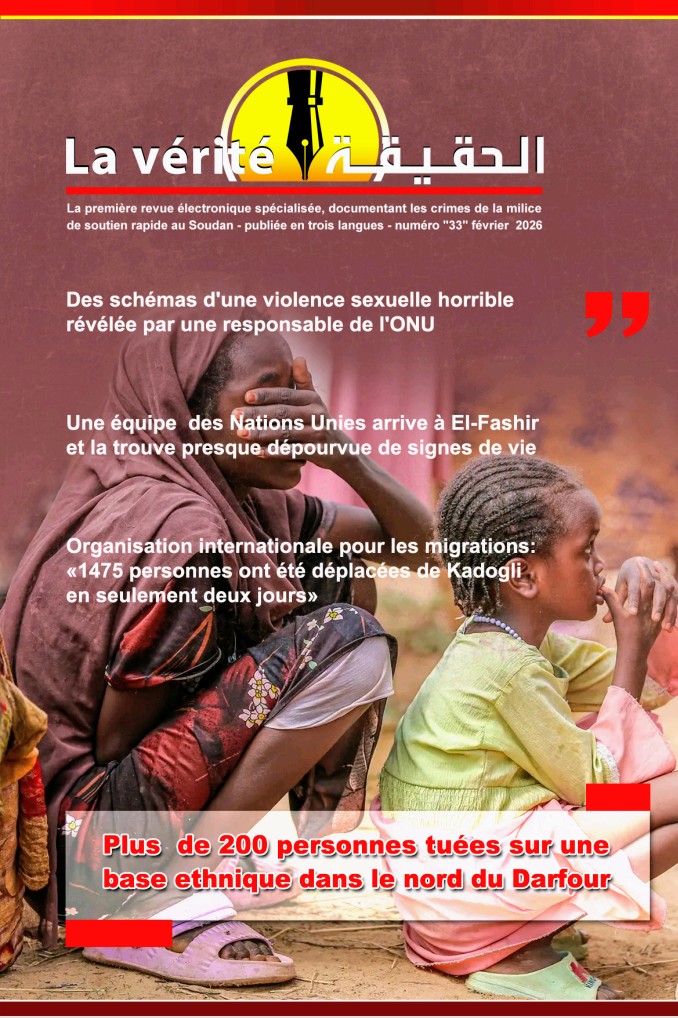

Al-Haqiqa
The first specialized electronic periodical magazine documenting the crimes of the Rapid Support Forces (RSF) militia in Sudan – published in three languages to serve as a reference for international organizations and mechanisms concerned to protect human rights worldwide – version 33 – February 2026
Introduction
The UN High Commissioner for Human Rights, Volker Türk, expressed his deep concern regarding the horrific crimes committed during and after the RSF’s takeover of El Fasher. He voiced his fear of a repeat of the scenario in Kordofan, stating that the RSF’s violations against civilians in Sudan, including targeting infrastructure, sexual violence, and extrajudicial killings, could amount to war crimes. He added that the attacks on the Marrawi Dam and hospitals constituted a grave violation of international humanitarian law. For its part, the International Criminal Court (ICC) confirmed that RSF committed genocide in Darfur. The images emerging from Darfur are horrific, and the Prosecutor concluded that RSF committed war crimes in El Fasher. What happened in El Fasher was organized and widespread mass murder, and the people of Darfur are being subjected to mass torture. Despite all these international confirmations and condemnations, RSF and its sponsors continue their actions. United Arab Emirates is accused of committing atrocities against civilians, including women, children, and the elderly, through the systematic and barbaric targeting of service facilities, the destruction of infrastructure, and the perpetration of ethnic cleansing and extrajudicial killings.
Al-Haqiqa, in its 33rd version, documents horrific patterns of violations committed by RSF militia in camps of internally displaced persons (IDPs), as well as sexual violence and ethnic killings perpetrated by the militia in north Darfur and south Kordofan. Al-Haqiqa also highlights the report of UN team that recently visited El Fasher and found it almost devoid of any signs of life. Through recent figures and statistics, Al-Haqiqa reveals the militia’s violations in the health sector and vital facilities. It sheds light on the situation of IDPs in the northern State and exposes how UAE contributes to the ongoing violence in Sudan by intensifying airlifts to Ethiopia and from there to Sudan. Al-Haqiqa further reveals how companies registered in London are involved in recruiting mercenaries to fight in lines of RSF militia and how the UAE contributes to destabilizing security and stability in the region.
Al-Haqiqa documents
Horrifying Patterns of Sexual Violence revealed by UN Official
In early 2026, in an interview with Al Jazeera, Reem Alsalem, the UN Special Rapporteur on Violence against Women, revealed horrifying details of what she witnessed during her mission to Sudan. She described the situation as catastrophic and far worse than she had expected or read about. Alsalem stated that she found widespread and systematic sexual violence perpetrated on a massive scale. She explained that many of the women and girls she spoke with had been subjected to brutal rape, including collective rape and rape in front of family members. She added that the effects of these crimes are not limited to direct physical harm, but also leave deep and lasting psychological trauma, affecting not only women and girls, but also men who were forced to witness these violations. She pointed out that the inability of men to protect their families in such circumstances constitutes a heavy psychological and social burden within Sudanese society.
She emphasized that this makes sexual violence an extremely sensitive and difficult issue within Sudanese society, where social stigma still prevents many survivors from reporting their experiences. According to Al-Salem, this violence, along with other forms of abuse, was deliberately used as a weapon of war to destroy Sudanese society by tearing apart its social fabric and dismantling its cohesion.
Reem Al-Salem explained that the women she interviewed came from areas controlled by RSF and allied militias, stressing that these groups should be held accountable for what happened. She said she spoke with a large number of women and girls who had fled El Fasher, Kordofan, and other areas, arriving in dire humanitarian conditions after living under siege, suffering from hunger, and enduring long journeys.
Speaking about her own experience, Reem Al-Salem said there were certain stories she couldn’t easily overlook, noting the numerous cases she encountered during her journey. She also highlighted something that deeply affected her, something she hadn’t realized before the visit: the first and most immediate line of support for those displaced and affected by the war was not international organizations, but rather the local Sudanese communities themselves. These communities opened their doors and homes, sharing what little they had with those arriving from Darfur, Kordofan, and other war-affected areas.
She added that the suffering was not limited to those fleeing Darfur and Kordofan. Many Sudanese civilians endured immense hardship during the RSFs’ control of Khartoum for nearly two years, as well as Wad Madani and parts of Gezira state. In addition to sexual violence against women, Al-Salem spoke of widespread economic violence, saying she had never imagined the scale of the looting or the level of property destruction, from homes to the theft of crops and gold, and even the confiscation of small sums of money from individuals. According to Reem Al-Salem, this was accompanied by the deliberate humiliation of civilians and the systematic destruction of infrastructure. She emphasized that what she witnessed were not isolated incidents, but rather a widespread and organized pattern of violations and devastation.
Sulima Ishaq: RSF militia has intensified forced recruitment operations in West and South Kordofan states, targeting young age groups, in the absence of any humanitarian or legal considerations.
For her part, Sudanese Minister of State for Social Development and Human Resources, Sulima Ishaq, revealed what she described as a dangerous escalation in violations committed by RSF militia against civilians. She confirmed that the government had received documented reports indicating a widespread expansion in the forced recruitment of children and youth, in addition to systematic violence against women in several areas of the country. In media statements in January 2026, the minister said that RSF militia had intensified its forced recruitment operations in West and South Kordofan states in recent weeks, targeting young age groups, in the absence of any humanitarian or legal considerations. She considered these practices a blatant violation of all international laws.
Accusations of systematic violations
Ishaq explained that the reports received by her ministry speak of a recurring pattern of violations, including the siege of cities, the targeting of civilian areas, and the use of violence against women as a means of pressure in the context of war, with the aim of breaking local communities and forcing them into submission. She added that these actions cannot be separated from attempts to exploit the issue of civilians to achieve political gains, stressing that the Sudanese government views these incidents as serious crimes that warrant accountability.
Alarming Figures and Testimonies
The minister indicated that what has been officially documented does not reflect the true extent of the violations due to social concerns and psychological complexities that prevent reporting. She noted that hundreds of cases have been documented in various areas, some involving girls under the age of fifteen. She explained that government teams, in coordination with relevant authorities, were able to reach survivors after regaining control of several areas, revealing extremely complex humanitarian cases requiring urgent health and psychological support.
Social and Humanitarian Challenges
Sulima Ishaq spoke of the significant difficulties in addressing these cases, given complex social traditions and a shortage of specialized care centers. She emphasized the need for a comprehensive approach that is not limited to security measures alone, but also includes psychological and social support and community reintegration. The minister stressed that RSF violations represent a direct threat to the social fabric of Sudan, warning of long-term repercussions if they are not addressed decisively. She called on the international community and relevant organizations to play their role in protecting civilians and supporting accountability efforts.
Al-Haqiqa Documents
UN Team Arrives in El Fasher and Finds It Almost Devoid of Life
On December 31, 2025, Al Jazeera broadcast a report on the UN delegation’s visit to El Fasher. According to the channel, the UN team described El Fasher as a “massive crime scene,” with strong indications that RSF militia (Janjaweed) had carried out extensive clean-up operations to remove evidence of crimes. The team also expressed serious concerns about civilians still being held captive inside the city, in addition to wounded individuals in need of urgent medical evacuation. They emphasized the need to ensure that humanitarian aid left in El Fasher does not fall into the hands of any party other than the civilians in need.
The report also addressed the waves of mass displacement from the city, with more than 100,000 people fleeing El Fasher. Many families were forced to walk for days, and sometimes weeks, to reach the neighboring White Nile State. Al Jazeera’s correspondent reports that the UN visit did not afford sufficient opportunity for a thorough investigation, as it was at the invitation or with the approval of RSF militia (Janjaweed), and under their direction. This prevented a complete picture from emerging and highlighted the need for a UN mission to return under more conducive circumstances to uncover the extent of the violations and gather evidence.
The report added a particularly grim humanitarian dimension through field testimonies relayed by a field coordinator working in North Darfur with Solidarity International. He met survivors who arrived in the Tawila area after fleeing El Fasher. The humanitarian official recounted recurring stories that were almost identical in their details, including testimonies from women who said, “I was sexually assaulted, and my husband was killed before my eyes,” and others who reported being raped two or three times while trying to escape. He also documented testimonies of the rape of underage girls, some as young as fourteen and others as young as seven, along with accounts of looting and violence targeting various communities along displacement routes.
The report also cited testimonies of extrajudicial and cold-blooded killings in El Fasher targeting civilians attempting to flee the city. The organization’s coordinator confirmed that these stories were repeated almost identically with each group of displaced people, regardless of their backgrounds or regions, leading him to assert that what is happening is not isolated incidents, but rather a systematic pattern of violations. He concluded that this violence constitutes a war strategy aimed at destroying the social fabric, the community, and its dynamics, which explains why the majority of displaced people reached by humanitarian organizations after months of fighting are women and children.
The importance of this report becomes clear when placed within its broader media context, especially given the desperate attempts by the UAE-based Sky News Arabia to create the misleading impression that El Fasher is a vibrant city and that the situation there is normal. This coincides with the activity of organized networks of automated social media accounts, funded by the UAE, which promoted a narrative claiming that “El Fasher is fine” and that reports of crimes are exaggerated.
RSF Detain 600 Women in South Darfur Prisons
January 5, 2026
According to Darfur24, RSF are detaining 600 women, some with their children, in Korea Prison in Nyala, South Darfur State. women are suffering from dire humanitarian conditions due to prolonged detention and shortages of drinking water and food. A guard at the Korea Prison told Darfur24 that more than 600 women are being held on weak charges. She indicated that more than 50 children are staying with their mothers in the prison, explaining that the women were arrested from cities and areas in Kordofan, North, Central, and South Darfur. In a related matter, a former detainee at Kober Prison, who was released about a month ago, told Darfur24 that the prison holds a large number of women distributed across five overcrowded wards. She explained that the humanitarian situation inside the prison is extremely difficult, with drinking water sometimes unavailable and food rations insufficient.
Al-Haqiqa Documents
WHO: 1,858 Sudanese Killed in 201 Attacks on Hospitals:
January 11, 2026
World Health Organization (WHO) reported that it has verified 201 attacks on healthcare facilities, resulting in the deaths of 1,858 people and injuries to 490 others since the conflict began in April 2023. These attacks have undermined access to life-saving care and placed healthcare workers, patients, and service providers at grave risk. In a statement issued on January 11, 2026, WHO stated that the war in Sudan has left more than 20 million people in need of health assistance, while 21 million are suffering from acute food insecurity. The organization further explained that 33.7 million people in Sudan will require humanitarian assistance this year, following nearly three years of continuous violence, severe access restrictions, and declining funding. WHO indicated that the health system has been severely impacted by the ongoing fighting, the increasing number of deadly attacks on healthcare facilities, mass displacement, and shortages of medical supplies. The primary challenges include a shortage of healthcare workers and a lack of funding.
She added: “Despite the efforts of WHO and its partners to restore and revitalize health services across the country, more than a third of health facilities (37%) remain out of service, depriving millions of people of essential and life-saving services.” WHO Representative in Sudan, Shibl Sahbani, stated that the conflict has pushed the health system to the brink of collapse, leaving people facing a devastating situation with disease, hunger, and lack of access to basic services. He explained that the number of internally displaced persons is currently estimated at 13.6 million, and that deteriorating living conditions, overcrowding in displacement sites, disruption of health, water, sanitation, and hygiene services, and the collapse of routine immunization programs are leading to disease outbreaks.
Sudan Doctors Network: Three major hospitals in Dilling, South Kordofan, out of service; four medical personnel killed in deliberate shelling by RSF and SPLM-N militias
In January 2026, Sudan Doctors Network reported a sharp deterioration in the health situation in Dilling, South Kordofan, following attacks by RSF and SPLM-N led by Abdelaziz al-Hilu on several health facilities. This resulted in the closure of a number of hospitals and medical centers, and the shutdown of vital departments, exacerbating the suffering of citizens and reducing the availability of basic healthcare services. Meanwhile, some facilities were operating with limited resources to cover emergency needs due to the ongoing systematic shelling.
The report also noted that three major hospitals in Dilling, South Kordofan, were out of service and four medical personnel were killed in the attack. Since April 2023, the Sudanese Doctors Network has documented the killing of over 234 medical personnel, with more than 507 injured and over 59 missing, their fate still unknown. Additionally, 73 medical personnel were detained in Nyala under extremely poor conditions. The network confirmed in its reports that these figures reflect the scale of the targeting and grave violations against healthcare workers, in blatant contravention of international laws guaranteeing the protection of medical personnel and facilities during conflicts.
Al-Haqiqa Documents
Over 200 People, Including Children and Women, Killed on Ethnic basis in North Darfur:
In January 2026, the Sudanese Doctors Network reported that over 200 people, including children and women, were killed on ethnic grounds by RSF militia in the areas of Ambro, Sarba, and Abu Qumra in North Darfur. Sources from the Sudanese Doctors Network, based on testimonies from survivors who arrived at displacement camps in the Al-Tina area of Chad, revealed that over 200 people, including children, women, and men, were targeted and killed on ethnic basis in the Ambro, Sarba, and Abu Qumra areas following an attack by the RSF militia, in flagrant violation of all humanitarian and international laws.
Al-Haqiqa Documents
Secret Emirati Military Airlift to Ethiopia
Open-source intelligence expert Rich Tidd revealed that the last few months of 2025 saw a steady increase in military cargo flights linked to the United Arab Emirates to Ethiopia, particularly between October and November 2025. However, the largest increase occurred recently, between December 10 and 19. During this period, Rich Tidd, an independent open-source intelligence researcher, meticulously tracked these flights, seeking to understand their nature and the reasons for this sudden increase.
Details of the Airlift Operation
Between October 6 and December 19, 2025, 36 UAE military flights were recorded arriving in Ethiopia. These included one flight by a UAE Air Force C-17A military transport aircraft and 27 flights by Il-76TD cargo aircraft operated by commercial airlines, including Zippo Air and FlySky Airlines from Malawi, and New Way Cargo Airlines from Kyrgyzstan. Additionally, Moldova-based Bectox Air Cargo operated four flights using a B747-409F freighter.
The flight schedule also included the arrival of an Antonov An-124-100 heavy transport aircraft (registration number UR-ZYD) belonging to Maximus Air, a company linked to the UAE government. This aircraft departed from Al Reef Air Base in Abu Dhabi for Mombasa, Kenya, before continuing directly to Addis Ababa Bole International Airport. It was followed by a UAE government-owned Boeing 737-436 passenger aircraft (registration number 5Y-FQA) operated by Kenya-based Vangate Express.
Maximus Air flight to Ethiopia via Mombasa
Two flights were observed on October 11 and November 16 involving a UAE Air Force CL-600 aircraft, which landed at Bole International Airport. This aircraft is typically associated with flights of the UAE Armed Forces General Staff, including those of the Chief of Staff, Lieutenant General Al-Zaabi.
Suspicious flights linked to the UAE arrived in Ethiopia between October and December 2025.
Rich says a significant increase in air traffic during the last week of December, from 10 to 19, with 13 flights recorded, averaging nearly two flights per day. This represents a daily average more than three times that of the first ten days of December, which saw only four flights. Notably, the number of flights recorded in these last days of December alone exceeds the total number of flights recorded throughout November.
IL-76TDs at Harar Meida Air Base
Satellite imagery dated November 25 and December 12 confirmed the presence of two Il-76TD cargo aircraft at Harar Meida Air Base in Bishoftu, Ethiopia. The first aircraft, spotted on November 25, is believed to be an Il-76TD belonging to Fly Sky Airlines (registration number: EX-76003). The aircraft took off from Bossaso Airport in the Puntland region of Somalia, headed west, and contact was lost while it was flying at an altitude of approximately 28,000 feet over Dire Dawa, Ethiopia. This movement coincided with the aircraft being imaged by the Sentinel-2L1A satellite on the same day.
The aircraft then made at least two flights between Bossaso Airport and Harar Mida Air Base on November 25 and 26. Prior to this, it had arrived in Bossaso from Al Reef Air Base in Abu Dhabi, a major hub for Emirati military flights to Africa.
The second aircraft, identified in Sentinel-2L1A satellite imagery dated December 12, is believed to be an Il-76TD belonging to Aviacon Zitotrans, an airline sanctioned by the Office of Foreign Assets Control (OFAC). The aircraft, registration number RA-76842, departed from the UAE Air Force base in Abu Dhabi on the same day and contact was lost while flying over the Gulf of Aden.
Rare cargo flight arrives at Bahir Dar Airport
On December 18, an Il-76TD cargo plane, confirmed to have departed from Abu Dhabi’s Al Reef Air Base, was spotted arriving at Bahir Dar Airport in the Amhara region of Ethiopia. The aircraft then proceeded to Bole International Airport in Addis Ababa before returning to Abu Dhabi later that night. This is the first documented instance of a cargo plane of this type operating directly from the UAE to Bahir Dar. The aircraft, registered as EX-76026 and operated by New Way Cargo Airlines, has been active in recent weeks on routes between UAE and Chinese air bases, and it is likely that it was transporting Chinese-made military equipment. It is worth noting that Bahir Dar Airport underwent a renovation between May and June 2025. The work included completely resurfacing the runway with new asphalt and markings, as well as rehabilitating the main aircraft parking apron, especially the left section which was previously inoperable.
Renovation Work at Bahir Dar Airport
Renovation of Harar Meida Air Base
Harar Meida Air Base has been temporarily closed since late September 2025, necessitating the diversion of cargo flights to Addis Ababa Bole International Airport. The closure was due to a comprehensive renovation that lasted approximately one month.
Renovation Work at Harar Meida Air Base
The work focused on rehabilitating the main runway, including laying a new asphalt surface and installing new runway markings. Additionally, the runway was extended by approximately 820 meters, increasing its total length from 3.1 kilometers to 4 kilometers. This upgrade made Harar Meida Air Base’s runway the longest in Ethiopia, significantly enhancing the air base’s operational capacity.
Mysterious Military Shipments Through Somaliland
In November 2025, video footage emerged confirming the transfer of a large shipment of military equipment from the port of Berbera in Somaliland to Ethiopia. The shipment included containers loaded with weapons and ammunition, as well as at least 21 pickup trucks modified for military use. Through independent verification, I was able to confirm that the shipment ultimately reached Ethiopia. Geolocation analysis of the video footage indicates that the convoy was en route to Dire Dawa, Ethiopia, providing clear evidence of the destination and movement of this military equipment across borders. Some unconfirmed reports suggested that these vehicles arrived at the port of Berbera on a cargo ship coming directly from the United Arab Emirates. This is noteworthy, as the port of Berbera is managed and operated by DP World Group, a UAE-based. Other claims alleged that the shipment was destined for RSF. However, it is worth noting that arms shipments to the Ethiopian National Defense Forces typically transit through Kenya or Djibouti, or are delivered directly to Ethiopia by air, rather than passing through Berbera.
Is this related to the war in Sudan?
There is no conclusive evidence directly linking these flights to the ongoing conflict in Sudan. However, their timing coincides with reports that Ethiopia is now allowing RSF to operate in the Benishangul-Gumuz region near the Sudanese border. Furthermore, Al Jazeera reported that the Sudanese Armed Forces are preparing to open a potential new front against the RSF along Blue Nile State, through Ethiopian territory. Reports also indicate that Ethiopia is increasingly serving as a transit hub for weapons and logistical supplies allegedly being sent by the UAE to the RSF. These shipments reportedly arrive by sea at the Kenyan port of Mombasa or the port of Berbera in Somaliland, before being transported overland through Ethiopia to ultimately reach the RSF.
Al-Haqiqa Documents
A Reuters report, using evidence, maps, and satellite imagery, traces how a remote airstrip in southeastern Libya transformed into a pivotal logistics hub that reshaped the course of the war in Sudan:
In late December 2025, a Reuters report revealed that Al-Kufra Airport, located in a vast desert region and controlled by the Libyan National Army (LNA) under Khalifa Haftar, had become a vital supply line for RSF militia after previous supply routes through eastern Chad became complicated due to political pressure. With the center of gravity of the war shifting from Khartoum to Darfur following the militia’s retreat from the capital, reopening supply lines from Libya became a pressing military necessity. The report detailed how Al-Kufra Airport underwent significant development during 2024, including renovating its facades, constructing new hangars, and receiving regular flights from Benghazi, coinciding with an unprecedented increase in the number of heavy cargo planes appearing in satellite imagery. Analysis of Copernicus imagery and flight tracking data indicates that these aircraft were not present the previous year, then began appearing in large numbers starting in April, peaking just before the fall of El Fasher.
The report, based on testimonies from more than 30 officials, military and diplomatic experts, as well as UN reports and independent analyses, confirms that this air corridor facilitated the transport of weapons, fuel, and fighters who supported the 18-month siege of El Fasher and enabled RSF militia to consolidate its control over Darfur and subsequently achieve territorial gains in South Sudan.
The report also links cargo flights to Kufra to airlines previously accused in UN reports of transporting weapons from the UAE to Haftar’s forces in Libya, such as Sapsan Airlines and FlySky. The report documents the arrival of Ilyushin-76 aircraft from Dubai and from Bossaso in Somalia’s Puntland region, where the UAE is involved in training and funding local security forces. It places these developments in a broader context, noting repeated accusations from UN experts and the US Congress of Emirati support for RSF militia, despite Abu Dhabi’s repeated denials. The report also cites an official complaint filed by the Sudanese army with the UN alleging that Colombian mercenaries crossed through Kufra to support the militia.
The Reuters report concludes that Kufra Airport is no longer a marginal facility but has become a regional logistics hub that has been a game-changer in the Sudanese war, contributing to the prolongation of the conflict and the deepening of the humanitarian catastrophe, amidst continued international inability to stem the flow of weapons or hold those responsible for fueling the war accountable.
Al-Haqiqa Documents
Militias Intensify Targeting of Civilians and Vital Infrastructure via Drones
The media office of the Sudan Electricity Company stated that the Al-Obied power station was attacked by drones at dawn on Sunday, January 4, 2026, resulting in direct hits and a fire in the machinery building. This led to a power outage. Civil Defense forces exerted significant efforts to extinguish the fire, and a technical assessment of the attack’s impact will be conducted to determine the necessary repairs. The militia also targeted Kenana Air Base in White Nile State with drones at dawn on the same day, but the attack was repelled, according to military sources.
Ten citizens, including nine from the same family, were killed in a drone attack on Al- Obied
On January 5, 2026, ten citizens, including nine members of the same family, most of them children, were killed in an attack carried out by a drone belonging to RSF militia. The attack targeted a citizen’s home in Al-Abyad, the capital of North Kordofan State.
Local sources reported several injuries resulting from the shelling, and the wounded were transported to city hospitals for treatment.
The martyrs are:
- Ahmed Al-Nour Abdullah
- Aya Al-Nour Abdullah
- Abdulrahim Ahmed Abdullah
- Nour Al-Islam Saleh Abdullah
- Amna Hamad Eid
- Omar Saleh Abdullah
- Talin Ahmed Abdullah
- Hawa Saleh Ahmed Abdulrahman
- Abdullah Ahmed Abdullah
- Maryam Abdulrahim Abdullah
On January 12, 2026, a military source revealed to Darfur 24 that several members of the security detail of security and military leaders were killed in a drone attack targeting a meeting of the security committee in Sinja, the capital of Sinnar State in southeastern Sudan. The source explained to Darfur 24 that the meeting included security leaders from Sinnar, White Nile, and Blue Nile states. He stated that the attack was carried out using a strategic drone. An eyewitness told Darfur 24 that Sinja Hospital received a number of wounded.
Al-Haqiqa Documents
International Organization for Migration: “1,475 People Displaced from Kadugli in Just Two Days”
The UN Migration Agency (IOM) reported that insecurity has forced more residents to flee Kadugli, Dilling, and Dalami in South Kordofan State. This displacement is a result of escalating attacks by SPLM-N and (RSF) militias on Kadugli and Dilling in recent weeks, amid fears of a ground assault on the two cities. In a statement, the IOM said that “1,475 people were displaced from Kadugli as a result of the worsening insecurity on December 21 and 22, 2025.” The statement indicated that these people fled to various locations in the localities of Al-Baram, Talodi, Abu Kushola, and Hebeila in South Kordofan, as well as Sheikan locality in North Kordofan and other locations in White Nile State.
Civilians face extreme difficulties reaching safe areas due to the siege imposed on the city by the SPLM-N militias and their perpetration of abuses against those fleeing eastward. Many civilians are forced to flee to Dilling, the second largest city in South Kordofan, and then attempt to reach El Obeid by passing through areas controlled by the Rapid Support Forces militia. This perilous journey is fraught with widespread violations, including killing, looting, arbitrary arrest, and rape.
Al-Haqiqa Documents
The Governor of Northern State Receives the High Commissioner for Human Rights, Volker Türk
On January 15, 2026, the Governor of Northern State, Lieutenant General Abdul Rahman Abdul Hamid Ibrahim, received the High Commissioner for Human Rights, Volker Türk, and his accompanying delegation at his office. Members of the National Human Rights Mechanism were also present. In press statements following the meeting, High Commissioner Türk explained that the visit aimed to assess the human rights situation in the state and the violations suffered by civilians.
Turk stressed that the visit comes within the framework of solidarity with Sudan, supporting the victims and survivors of militia violations, and providing them with the necessary assistance. He indicated that the visit program includes the Al-Afad camp in Al-Dabba locality to listen to the statements and testimonies of survivors of violations, in addition to visiting the Merowe Dam in Merowe locality, expressing his hope that peace and stability will prevail throughout Sudan. For her part, the Secretary of Social Affairs, Manal Makawi, explained that the High Commissioner received a comprehensive briefing on the humanitarian situation in the Northern State, indicating that the visit will include the Al-Afad camp in Al-Dabba locality to assess the conditions of the displaced, in addition to a visit to Merowe locality to see the effects of the Rapid Support Forces militia attacks that targeted electricity substations.
Manal emphasized the importance of reviewing the violations committed against civilians by the Rapid Support Forces militia, stressing that the visit would have a positive impact on the humanitarian situation and human rights in the state. For his part, the Commissioner for Humanitarian Aid in the state, Dr. Wael Mohamed Sharif, welcomed the High Commissioner for Human Rights’ visit to the Northern State, noting that the visit’s program included a field tour of the Al-Afad camp in the Ad-Dabba locality to assess the humanitarian conditions of the displaced, in addition to a visit to the Merowe Dam. He emphasized the importance of the visit and its role in highlighting humanitarian issues in the state.
The Truth Documents
Chairman of the Transitional Sovereignty Council Meets the International President of Doctors Without Borders
On January 15, 2026, the Chairman of the Transitional Sovereignty Council and Commander-in-Chief of the Armed Forces, Lieutenant General Abdel Fattah Al-Burhan, met the International President of Doctors Without Borders, Mr. Javed Abdel Moneim, in the presence of the Federal Minister of Health, Dr. Health Minister Haitham Mohamed Ibrahim explained in a press statement that Lieutenant General Abdel Fattah al-Burhan expressed his gratitude and appreciation for the organization’s efforts in Sudan during the meeting. He emphasized the importance of coordination and cooperation between the organization and relevant bodies working in the field of humanitarian aid and the provision of health assistance and services.
Dr. Haitham stated that the current phase requires increased efforts to meet the growing humanitarian and health needs, in addition to the ongoing efforts to rehabilitate and rebuild the country’s health institutions, which were largely destroyed by the rebel militia. The Chairman of the Sovereign Council commended the work carried out by Doctors Without Borders in eight Sudanese states, directing further support and coordination in the future. For his part, the International President of Doctors Without Borders, Mr. Javed, said that the meeting with the Chairman of the Sovereign Council was fruitful and constructive. He added, “We, as an organization, are proud to stand with the Sudanese people and provide them with health assistance and services in cooperation with our partners in the Ministry of Health.”
He indicated that the organization is working in eight Sudanese states and is eager to work in the remaining states. He praised the support the organization receives from relevant agencies and authorities, emphasizing that Sudan is a top priority for the organization.
Al-Haqiqa Documents
Somalia Cancels All Agreements with the UAE
January 12, 2026
Somalia has decided to cancel all agreements with the United Arab Emirates in response to Abu Dhabi taking steps that “undermine the country’s sovereignty, unity, and independence,” according to a statement from the Somali Cabinet. The statement explained that the Cabinet terminated all agreements with the UAE government, including those with government agencies, related entities, and regional administrations within the country. The statement added that this decision includes all existing agreements and cooperation at the ports of Berbera, Bossaso, and Kismayo. It further stated that the cancellation of agreements with the UAE, including security and defense agreements, came “based on strong reports and evidence concerning negative actions that affect the country’s sovereignty, national unity, and political independence.” Somalia affirmed that these actions violate the principles of sovereignty, non-interference in internal affairs, and respect for the constitutional order of the state.
The security agreement signed between the two countries, which focused on military cooperation and counterterrorism, stipulated that the UAE would provide support to Somali forces through training, equipping, and supplying weapons and equipment, as well as allowing them to conduct military and security operations within Somali territory. By sea and air, it also included clauses allowing the UAE to use Somali ports and airports, including the establishment of military bases. The Somali cabinet had approved the security agreement on February 6, 2023, in a move that remained the subject of widespread debate within Somali political circles and public opinion. International reports confirm that the UAE is destabilizing the entire region by supporting outlaw militias to divide the countries of the region.
