
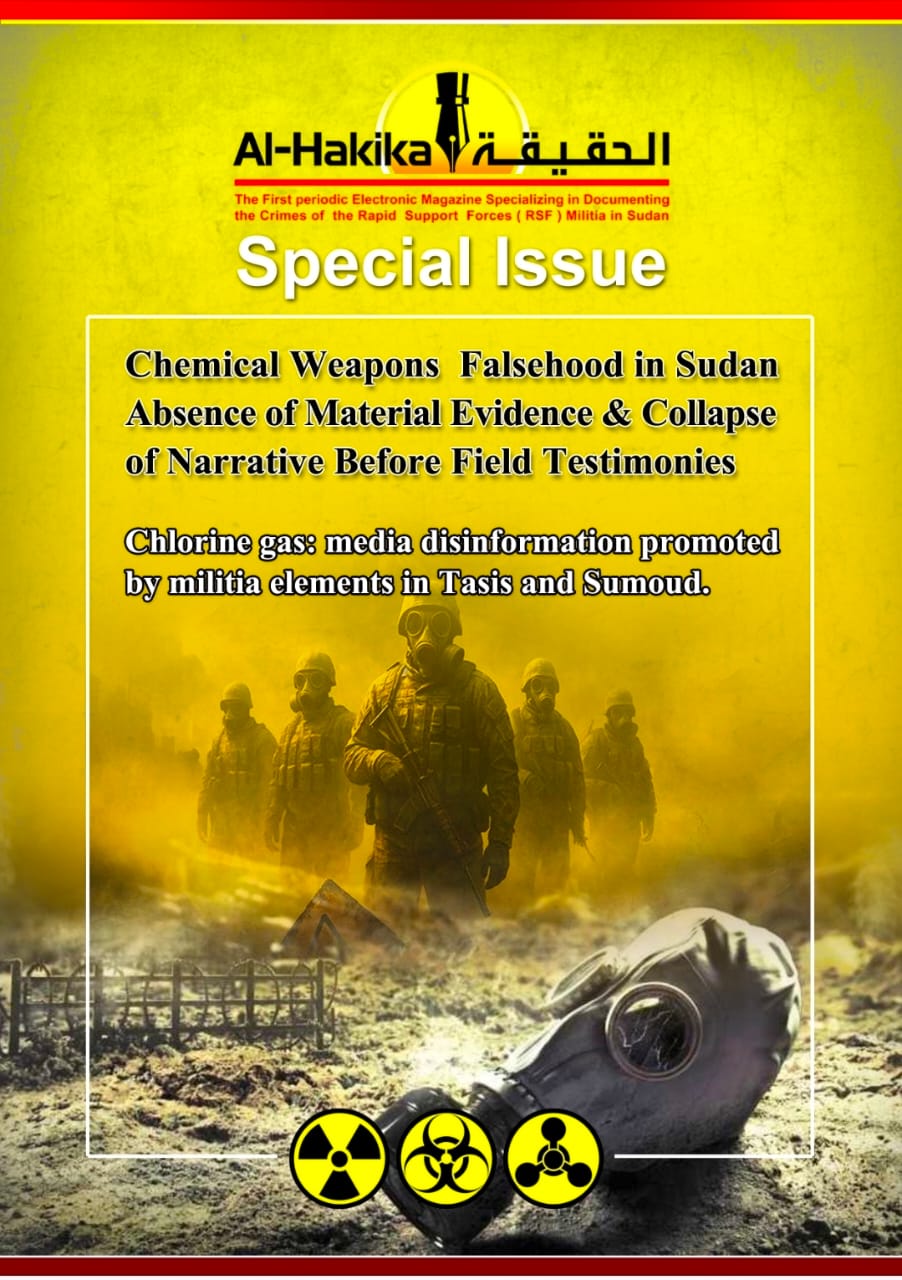
Chemical Weapons Falsehood in SudanAbsence of Material Evidence and Collapse of Narrative Before Field Testimonies

In the Name of Allah, the Most Gracious, the Most Merciful
Al Hakika
The first specialised periodical e-magazine dedicated to documenting the crimes of the Rapid Support Forces militia. Published in three languages, it serves as a reference for international organisations and mechanisms concerned with the protection of human rights worldwide.
Special Issue
Chemical Weapons Falsehood in Sudan
Absence of Material Evidence and Collapse of Narrative Before Field Testimonies
▪︎ The false claim that the army used chemical weapons was no more than a desperate last gasp, confined to the channels of the militia’s sponsor and fake accounts on social media platforms.
▪︎ Accusing a regular army in a war of this scale on the basis of video clips produced by its adversary requires critical scrutiny before being accepted as fact.
▪︎ The artificial intelligence colour-mixing operation is a baseless allegation rejected by the citizens of Khartoum before the army.
▪︎ Chlorine gas: media disinformation promoted by militia elements in Tasis and Sumoud.
▪︎ Anonymous officials form the evidence relied upon by Western and militia-aligned media to allege the use of chemical weapons.
▪︎ The narrative of chemical weapons use cannot be separated from the fragmentation and defeats suffered by the Rapid Support Forces militia.
▪︎ Eyewitnesses: We saw no trace of chemical weapons in Khartoum.
▪︎ Repeating these arbitrary accusations will not alter the reality of the situation. Rather, it underscores the depth of the crisis facing the militia.
Opening Note
Amid the systematic media escalation led by the terrorist Dagalo militias, their allies, and the parties sponsoring and financing them, false allegations and baseless claims have multiplied in an attempt to tarnish the image of the Sudanese Armed Forces by promoting claims that chemical weapons were used in the capital, Khartoum, namely liquid chlorine gas. These allegations lack any professional basis or credible evidence, and fall within the disinformation campaigns long pursued by these militias, the United Arab Emirates, and the militia’s political wing, including leaders of the so-called Tasis, Sumoud, and others. They represent desperate attempts to distort the facts and falsify reality through various media platforms, most notably UAE-based Sky News Arabia, alongside multiple fake social media accounts and analysts and experts affiliated with the militia and Abu Dhabi on channels loyal to the UAE and the Rapid Support Forces militia.
This fabricated narrative cannot be separated from the field realities now facing the militias, following the successive defeats they have suffered in Khartoum and the central states, where the Armed Forces have regained the initiative and cleared vast areas of armed militia positions.
The militias have sustained heavy losses in personnel and equipment, including the destruction of heavy machinery and supply depots, as a result of precise and organised military operations carried out by the army with a high degree of professionalism.
Administrative expert and political analyst Wael Abdelkhalig Malik told Al Hakika that since January 2025, accusations against the Sudanese Armed Forces of using chlorine gas in their battles against the rebel Rapid Support Forces militia have intensified. However, any careful examination of these accusations shows that many of them rest on fragile ground and fail to meet the basic standards of investigation.
He stated that even accusations issued from abroad, whether by the US Department of State or others, have not presented a single piece of material evidence to support these claims. Even the US Department of State relied solely on four anonymous officials quoted by The New York Times. As for the visual evidence cited by France 24, its original source was accounts loyal to the Rapid Support Forces on social media platforms. This is a direct party to the conflict with a clear interest in inflaming international opinion against the Sudanese army.
Wael added: More importantly, the substance referred to, chlorine gas, is not considered a chemical weapon in the strict sense. It is an industrial material originally used in the treatment of drinking water. Chemical expert Dan Kaszeta, consulted by France 24, acknowledged that proving death caused by this substance when released in open air is extremely difficult.
By contrast, the Sudanese army faces these accusations while waging a defensive war against a rebel militia internationally documented for genocide in Darfur, forced displacement affecting millions, and the systematic targeting of civilians. In addition, the United States imposed sanctions in the same month on figures affiliated with the Rapid Support Forces on parallel charges.
Wael Malik said the picture is more complex than the dominant narrative suggests. Accusing a regular army in a war of this scale on the basis of clips produced by its adversary requires human rights advocates and truth-seekers to pause critically before accepting such claims.
There is no doubt that political and media motives are at work, seeking to exert international pressure and raise the issue of chemical weapons in order to push the international community towards intervention or the imposition of international monitoring and sanctions on the Armed Forces. In practice, however, the first line of defence against this falsehood remains the citizen. Life is returning to normal without any complaints regarding what is being circulated in hostile media. The clearest evidence of this is the daily return of thousands to Khartoum through voluntary return journeys from Egypt, Uganda, and other places of refuge, displacement areas, and camps.
In this context, Sudanese journalist and political researcher Khalid Al Faki told Al Hakika that fragmentation and internal collapse have become clearly evident within the ranks of the militias, amid growing defections and splits among their leadership, as well as the joining of several of their members to the ranks of the Armed Forces. This reflects their loss of command cohesion and morale. This deteriorating field reality has driven their media mouthpieces to escalate their propaganda discourse in a desperate attempt to divert attention from their failures.
He added that the Sudanese Armed Forces, known for their national and moral commitment, continue to perform their duty in protecting the country and safeguarding its sovereignty in accordance with international laws and norms. Accordingly, the repetition of these arbitrary accusations will not alter the reality of the situation. Rather, it confirms the scale of the crisis facing the militias and their inability to confront the facts on the ground, prompting them to manufacture lies and promote them in a distressed media environment.
Political researcher Khalid Al Faki said: “As an eyewitness who lived through the details of daily life during the war, I categorically affirm that there has been no use of chemical weapons by the Armed Forces, contrary to what is being promoted by the militias and their media mouthpieces.” The water sources on which we depend for drinking and daily use have remained safe and clean, and we have observed no change in colour, taste, or smell, which are known initial indicators of any possible chemical contamination.
Al Faki added to Al Hakika that the general health conditions among citizens have shown no collective symptoms or unusual medical cases that could be linked to chemical substances. Life continues overall in a normal manner, despite the severity of economic conditions, with no field evidence of environmental contamination or prohibited weapons use. He further stated that these allegations lack factual evidence and fall within media disinformation campaigns aimed at distorting the truth and spreading panic among citizens at a time when they are most in need of accurate and reliable information.
The Secretary-General of the Alliance of Political and Civil Forces and Resistance Committees in Eastern Sudan, Saif Al Din Mohamed Ahmed Abunoura, told Al Hakika that what has circulated regarding the use of chemical or toxic weapons is nothing more than rumours and political counter-propaganda directed against the signs of stability and the normalisation of life in Khartoum. This, he said, stems from the militia’s and its supporters’ conviction that Khartoum will serve as the launchpad for the liberation of all Sudanese territory.
Saif Al Din added that the process of using artificial intelligence to mix colours, dye pools of water with such pigments, and circulate them across digital platforms is a crude operation that will not prevent displaced persons or refugees from returning to Khartoum.
He noted that all government departments have resumed their duties from Khartoum, and that political organisations have returned to clear debris from their offices and headquarters and resume their activities.
Abunoura affirmed to Al Hakika that since the return to Khartoum, no suspected case of poisoning caused by drinking water, food consumption, or inhalation has been recorded. Khartoum, he said, is free of any cases or suspected cases warranting an investigation into the use of chemical weapons, and only illnesses with known causes and treatments are present.
There is no doubt that repeatedly linking the Sudanese army to the use of internationally prohibited weapons in media reports aims to weaken the army’s legitimacy internally and externally, and to spread fear among civilians and within the forces themselves in order to undermine morale. However, these objectives have not been achieved because the facts on the ground refute them, making it impossible to create internal disruption. For this reason, the militia, through its various arms, continues to circulate these accusations and allegations across international platforms and outlets.
