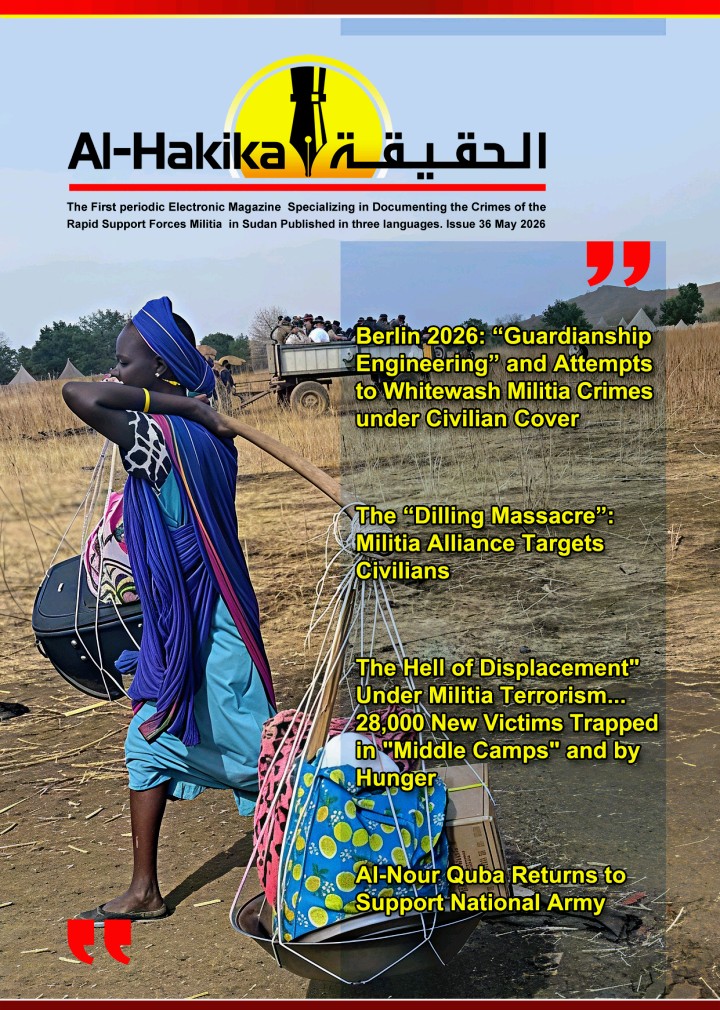
Blue Nile: Displacement Surges Under Militia Terror28,000 new victims trapped in makeshift camps and facing starvation.

Al-Haqiqa (The Truth)
The first specialized periodical electronic journal dedicated to documenting the crimes of the terrorist Rapid Support Forces militia. Issued in three languages to serve as a reference for international organizations and mechanisms concerned with the protection of human rights worldwide.
Issue No. 36 – May 2026
Introduction
The thirty-sixth issue of Al-Haqiqa is released at a critical juncture, as Sudan is witnessing a dangerous escalation in the pattern of crimes committed by the terrorist Rapid Support Forces militia. These actions are no longer isolated violations; rather, they constitute a “strategic pattern” aimed at destroying the foundations of life and enforcing demographic change through killing, displacement, and starvation.
This issue focuses on qualitative shifts in the crime landscape. From the technical “GB signature” proving the militia’s responsibility for the cross-border Al-Tina massacre, to the transformation of vast areas into “black holes” of enforced disappearance, we are confronted with a terrorist system whose brutality surpasses conventional models of armed conflict.
The files presented herein place the international community before urgent legal and moral obligations, most notably:
• Politicization of aid and “guardianship engineering”: Exposing attempts to “launder crimes” in international forums (such as Berlin 2026), where civilian narratives are exploited to provide political cover for a militia accused of war crimes.
• Sexual violence as a weapon of war: Documenting the use of rape and sexual violence as tools of ethnic cleansing and the subjugation of local communities in Darfur—constituting crimes against humanity.
• Healthcare destruction and systematic starvation: Targeting medical facilities and creating severe displacement crises (as in Blue Nile and Dilling), while highlighting the militia’s obstruction of relief efforts despite sovereign facilitation by the Sudanese government via the Adre crossing.
• Regional expansion of crime: Monitoring Libya’s transformation into a logistical platform supplying the militia with mercenaries and weapons, necessitating enforcement of international arms embargo mechanisms.
Through this trilingual documentation, Al-Haqiqa presents investigators and international bodies with a compelling “map of evidence,” affirming that the international community’s failure to designate this militia as a terrorist organization has effectively granted it a green light to turn Sudan into one of the greatest humanitarian tragedies of modern times.
This issue is not merely journalistic documentation—it is a legal “indictment document” aimed at preserving victims’ rights and preventing impunity.
)Al-Haqiqa… Document so the world does not forget, and so justice prevails(.
Al-Haqiqa Documents
Berlin 2026: “Guardianship Engineering” and Attempts to Whitewash Militia Crimes under Civilian Cover
On April 15, 2026, marking the third anniversary of the Sudanese war, the “Third Berlin Conference” repeated the failures of Paris and London. This report documents attempts by international actors to impose a political agenda bypassing Sudanese state institutions, aiming to legitimize a “civilian alternative” and provide cover for a rebel militia accused of genocide and grave violations.
First: Undermining National Sovereignty (Guardianship Approach)
Sudan’s Ministry of Foreign Affairs and Council of Ministers condemned the conference as a violation of international law and the UN Charter, noting it was held without consultation with the Sudanese government—reflecting a colonial-style guardianship approach.
Second: Unjust Legal and Moral Equivalence
The most dangerous aspect is equating the Sudanese Armed Forces with a multinational terrorist militia—placing a legitimate state institution on par with a group accused of ethnic cleansing.
Sudan believes that the organizers’ pretext of “neutrality” to justify not inviting the government is a “worthless” argument, as it equates the state with a militia that engages in ethnic cleansing and occupies civilian infrastructure.
Encouraging terrorism:
Excluding the government while giving a platform to the political wing of the rebels is a reward for the militia and its supporters and encourages terrorist movements in the region to follow the same approach of violating state sovereignty.
Third: Regional Bias and Fragmentation
Official sources reveal that the Berlin Conference seeks to impose the “Quartet” as the sole path, ignoring:
The Sudanese peace initiative proposed by Prime Minister Professor Kamil Idris in December 2025.
The Emirati role: Khartoum objects to the presence of regional parties (the UAE) that it considers part of the crisis and an instigator of the war, asserting that “those who ignited the war cannot be parties to achieving peace.”
The crisis of representation: The selective participation (entities affiliated with the “Founding” coalition) reflects implicit international acceptance of the idea of partitioning the country or imposing parallel governing structures resulting from the rebellion.
Fourth: Exploiting the Humanitarian File
Despite humanitarian rhetoric, international response remains limited (54%), rendering such conferences largely symbolic rather than impactful
Weak response: The actual international response to humanitarian needs has not exceeded 54%, rendering the conferences mere international public relations display.
Escaping reality on the ground: While the Sudanese army is making territorial gains, these platforms are attempting to halt this progress through “hotel seminars” instead of exerting real pressure to stop the violations and deliver aid through official channels.
Conclusion:
The outcomes of Berlin 2026 lack legal legitimacy and undermine genuine peace by sidelining Sudan’s sovereignty. The insistence of the “Quintet Group” on bypassing the Sudanese government and equating it with the rebellion places the international community in the position of obstructing genuine peace and contributing to the prolongation of the war by providing political safe havens for perpetrators of crimes against humanity in Sudan.
Any initiative that does not respect Sudan’s sovereignty and territorial integrity, and ignores existing state institutions, is an attempt to impose a new era of trusteeship, which the Sudanese people categorically reject.
Al-Haqiqa Documents
Sudan Turned into a “Black Hole” for the Missing
(April 14, 2026)
The International Committee of the Red Cross reports over 11,000 missing persons in Sudan—a 40% increase within one year—highlighting systematic escalation against civilians.
The militia’s policies include forced disappearance, infrastructure destruction, and family separation, creating prolonged psychological trauma and compounded crimes involving killing, detention, and sexual violence.
The Policy of Forced Disappearance and the Destruction of Family Ties:
Not content with internally displacing over 11 million Sudanese and forcing another 4 million to flee the country, the militias pursued a scorched-earth policy, destroying communications infrastructure and isolating entire regions from the world.
They tore apart family ties and prevented families from checking on their loved ones.
They created a state of constant psychological terror for thousands of families living on the false hope of learning the fate of their loved ones.
Complex Crimes: Between Murder, Disappearance, and Sexual Violence
The ICRC statement indicated that the cases of missing persons were accompanied by growing fears of widespread sexual violence and the collapse of protection systems in areas where the militias were active. This makes the issue of the “missing” a complex crime encompassing extrajudicial killings, enforced disappearances, and forced displacement.
Cries Behind Silence:
Reports included testimonies from mothers who have been missing for years, with their children spending their days searching through “lists of the missing” for a name that might restore their hope or end their agonizing wait. Despite the Red Cross facilitating hundreds of thousands of phone calls, thousands of cases remain open, bearing witness to the horrific crimes committed against the Sudanese people.
“What is happening in Sudan is not merely an armed conflict; it is a complete tearing apart of the social fabric and the loss of an entire generation under the weight of enforced disappearances and ongoing displacement.”
Al-Haqiqa Documents
The “Dilling Massacre”: Militia Alliance Targets Civilians
(March 29, 2026)
In a bloody escalation reflecting a blatant disregard for innocent lives, the Rapid Support Forces militia, in alliance with the Sudan People’s Liberation Movement-North (SPLM-N) faction led by Abdelaziz al-Hilu, committed horrific massacres against civilians in the city of Dilling, South Kordofan State. The intense and systematic artillery shelling, which targeted residential neighborhoods and crowded markets, resulted in the deaths of at least 14 civilians, including five children and two women, and left 23 others with varying injuries, according to initial reports that are expected to rise.
Systematic Targeting of Markets and Neighborhoods:
Field reports issued by the Sudanese Doctors Network confirmed that the shelling directly targeted residential areas and the city’s market during peak hours, causing widespread panic and leaving behind civilian casualties who had no connection to the military operations. These barbaric attacks come amidst a catastrophic health situation and a severe shortage of medical personnel and supplies, making the rescue of the wounded a losing battle against time.
The Suffocating Siege Plan:
Observers believe this military escalation clearly aims to reimpose a suffocating siege on Dilling, after the Sudanese army successfully broke its isolation, which had lasted for more than two years, last January. The attacking forces, employing a scorched-earth policy, seek to cut off supply routes once again and tighten the nose around hundreds of thousands of civilians, mirroring the catastrophic siege scenario experienced by El Fasher.
Grave Violations and International Appeals
The Sudanese Doctors Network and human rights organizations condemned this systematic targeting of civilians, describing it as a “flagrant violation of international humanitarian law” and a full-fledged war crime. Documentation platforms held the leaders of the Rapid Support Forces militia and the Sudan People’s Liberation Movement-North (al-Hilu faction) fully criminally and morally responsible for these massacres.
Al-Haqiqa Documents
Blue Nile:
“The Hell of Displacement” Under Militia Terrorism… 28,000 New Victims Trapped in “Middle Camps” and by Hunger
April 12, 2026
In a dangerous escalation affecting civilians in the Blue Nile region, data released by the International Organization for Migration (IOM) revealed the most violent wave of forced displacement since the beginning of this year. Attacks launched by the Rapid Support Forces militia, in alliance with the Sudan People’s Liberation Movement-North (SPLM-N), and supported by Ethiopian militias, have displaced thousands of families, turning their lives into an open-air tragedy.
These waves of displacement were not merely random escapes, but a direct result of military operations targeting populated areas.
The “Baw” area: The spark of displacement ignited last January.
The “Kurmuk and Qaysan” areas witnessed a bloody escalation in March, leading to the complete depopulation of entire villages.
Human toll:
According to the International Organization for Migration (IOM), 28,020 individuals (5,609 families) were documented as having fled in less than three months.
Second: “Informal settlements”:
The figures show that the militia not only expelled these people from their homes but also forced them into living conditions that fell below the most basic standards of humanity.
Al-Haqiqa Documents
Healthcare Genocide:
Systematic Targeting of Sudan’s Medical Sector
(April 2026)
The Sudanese healthcare system is facing a brutal war and systematic destruction led by the Rapid Support Forces (RSF) militia. The militia has moved from indiscriminate attacks to the direct targeting of medical personnel and hospitals through drone strikes and assassinations, resulting in the closure of dozens of healthcare facilities and depriving millions of citizens of their right to life and medical treatment.
First: The Jebelain Hospital Massacre (White Nile State)
On April 2, 2026, in a full-fledged war crime, a militia drone targeted Jebelain Hospital during rush hour, resulting in a humanitarian catastrophe.
Casualty Toll:
Ten (10) medical and administrative staff members were killed, and 22 (22) civilians, including children, were injured.
Prominent Martyrs:
▪︎ Dr. Hamed Suleiman Al-Nour
▪︎ Dr. Ilham Hamed Bishara (Hospital Director)
▪︎ Dr. Abed Mukhtar Bishara
▪︎ Qisma Mohamed Fadlallah (Anesthesia Technician).
Details of the attack:
The bombing occurred during a cesarean section and coincided with a children’s immunization campaign, destroying the operating rooms and emergency department.
Expansion of the aggression:
The simultaneous bombing targeted medicine and fuel depots in the neighboring city of Rabak.
Second: Physical elimination of medical personnel (Nyala – South Darfur)
The report documented a barbaric approach to eliminating specialist personnel. Militia elements stormed the home of Dr. Mohamed Ahmed Ali Al-Siddiq (a pediatrician at Nyala Teaching Hospital) and assassinated him in cold blood after brutally assaulting him, to terrorize medical staff and force them to evacuate the area.
Third: Destruction and looting of health facilities (Kurmuk, Al-Daein, and Dilling)
In Kurmuk, the militia launched an attack that rendered the city’s hospital inoperable after looting the pharmacy, stealing medical equipment, and assaulting doctors. This resulted in the forced displacement of more than 3,000 citizens.
In Al-Daein: Militias stormed the Family Hospital in the Al-Nadhir neighborhood under the protection of what they call the “militia’s civilian administration,” assaulting doctors and destroying medical equipment.
In Dilling: The Health Insurance Hospital was directly shelled to destroy the last remaining healthcare facilities for citizens in the area.
Fourth: International Condemnations and Positions
This escalation sparked widespread condemnation, including:
The Sudanese Ministry of Foreign Affairs, which described the attacks as terrorist acts and a blatant violation of international norms.
The Sudanese Doctors’ Union held the militia criminally and morally responsible and considered the international community’s silence a green light for the continuation of these crimes.
The State of Qatar condemned the targeting of Al-Jabalain Hospital, deeming it a violation of international humanitarian law.
The Muslim World League denounced the heinous criminal act and called for adherence to the Jeddah Declaration for the Protection of Civilians.
The United Nations (WHO & UNICEF) warned of the increasing attacks on health facilities, which deprives communities of life-saving care. What the Rapid Support Forces militia is doing to the health sector is not just a side effect of the war, but a comprehensive destruction strategy targeting the foundations of life.
Al-Haqiqa Documents
Shocking Report: Doctors Without Borders Documents Sexual Violence as a “Weapon of Genocide”
(April 2026)
In yet another international condemnation adding to its record of crimes, Doctors Without Borders (MSF) revealed in a recent report a horrifying and systematic escalation of sexual violence perpetrated by the Rapid Support Forces (RSF) militia and its allied groups in Darfur. The report emphasized that these crimes are not isolated incidents, but rather a deliberate strategy aimed at humiliating the community, spreading terror, and forcibly displacing the population.
Sexual Violence:
A Weapon of War and a Method of Subjugation
The organization confirmed that sexual violence has become a defining characteristic of the ongoing conflict, used by the militia as a systematic tool of repression to subjugate civilians. The report stressed that these practices constitute a flagrant violation of international humanitarian law and fall under the categories of war crimes and crimes against humanity.
Terrifying Figures
The organization documented statistics reflecting the scale of the catastrophe, emphasizing that the reported figures represent only the tip of the iceberg due to security restrictions and social stigma. It noted that 3,396 survivors received treatment at MSF facilities during 2024 and 2025.
Ethnic Targeting:
The organization documented cases of repeated gang rape targeting women and girls based on their ethnicity.
The Zamzam and El Fasher Massacres: The report recorded unprecedented atrocities that accompanied the attack on the Zamzam camp for displaced persons and the fall of El Fasher, violations that UN missions described as amounting to genocide.
The organization relayed harrowing testimonies from survivors who were raped multiple times as part of a campaign of terror aimed at fracturing the social fabric of the targeted communities.
The findings of the Doctors Without Borders report place the international community before its moral and legal responsibility, and documenting these crimes is the first step towards accountability and ending impunity.
Al-Haqiqa Documents
Sudan Extends Opening of Adre Crossing to Counter Starvation Policy
(March 31, 2026)
In a move that underscores the Sudanese government’s sense of responsibility towards citizens besieged by the crimes and violations of the rebel militia, the Sudanese Ministry of Foreign Affairs announced an official decision to extend the opening of the Adré border crossing with Chad for an additional three months, from the beginning of April until the end of June 2026.
A Humanitarian Commitment in the Face of the Siege
The Ministry of Foreign Affairs stated that this decision aims to ensure the flow of humanitarian aid delivered by international relief organizations and to prevent the terrorist militia from exploiting the suffering of civilians for its own gain. The statement emphasized that the move reflects the government’s commitment to delivering food and medicine to every corner of Sudan, despite the security challenges posed by rebel attacks on aid routes.
International Coordination and National Controls
The government stressed that the extension of the crossing’s operation is being carried out in accordance with joint coordination mechanisms with UN agencies and in compliance with international humanitarian law. It also emphasized the need for strict monitoring and controls to ensure that aid reaches its intended recipients and prevents it from falling into the hands of the militia, which has a history of looting aid convoys and using them to further its war effort.
Observers believe that the Sudanese government’s decision places the international community before its direct responsibility. While the state opens border crossings and airports to alleviate the crisis, the Rapid Support Forces militia continues to use “hunger” as a weapon of war, looting warehouses and obstructing convoys in the areas it controls. Documenting these crimes is therefore essential to ensure that the perpetrators do not escape international punishment.
Al-Haqiqa Documents
The “GB Signature”: Technical Evidence Links Militia to Al-Tina Massacre
(April 2026)
Field investigations, bolstered by digital forensics, have revealed the explicit involvement of the Rapid Support Forces (RSF) militia in the treacherous airstrike that targeted the town of Al-Tina inside Chadian territory. This attack resulted in the deat
