
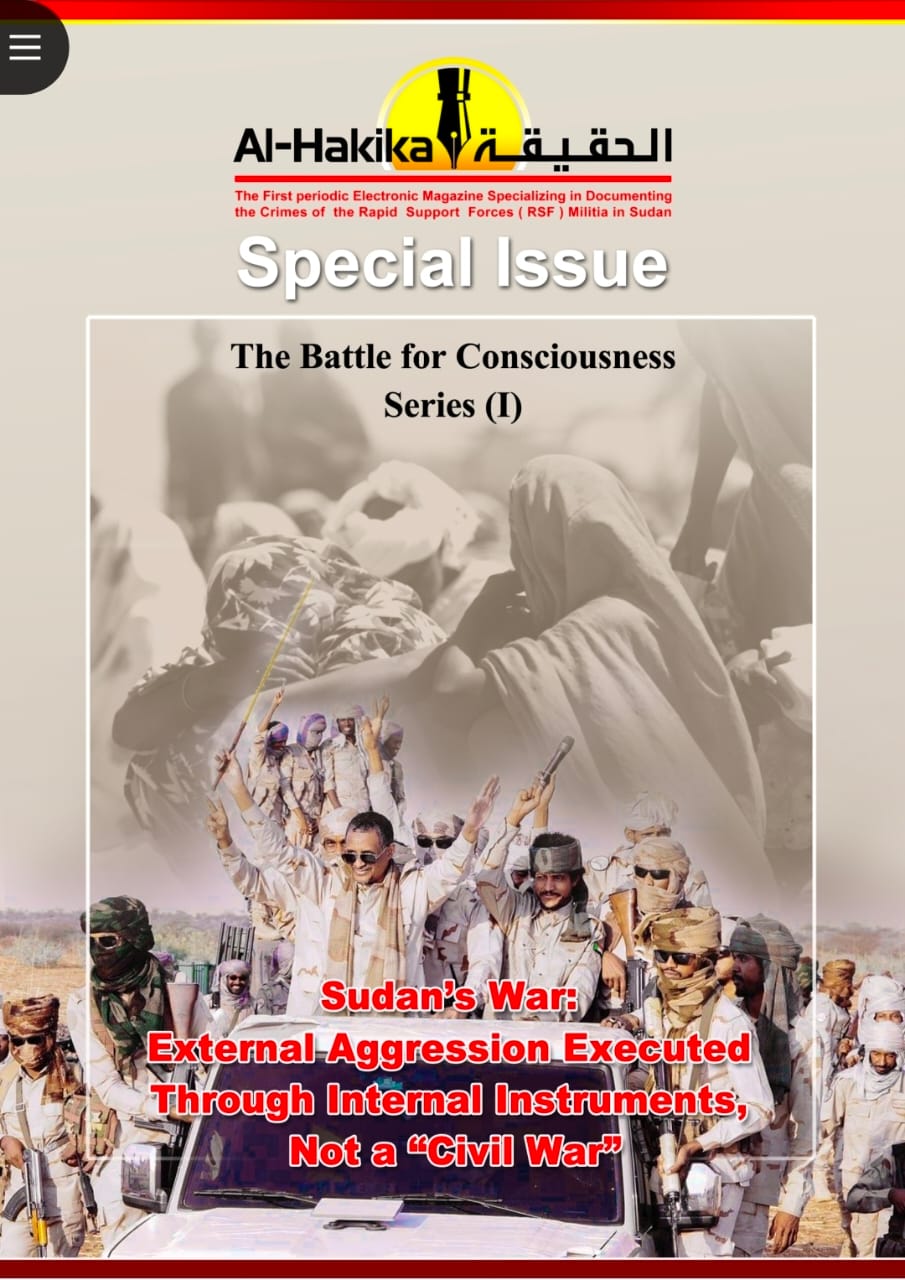
Al HakikaThe First Periodic Digital Magazine Dedicated to Documenting the Crimes of the Rapid Support Forces Militia

Al Hakika
The First Periodic Digital Magazine Dedicated to Documenting the Crimes of the Rapid Support Forces Militia
Published in three languages, Al Hakika is conceived as a specialist reference for international organisations and mechanisms concerned with the protection of human rights worldwide.
Special Edition
The Battle for Consciousness Series (I)
Sudan’s War: External Aggression Executed Through Internal Instruments, Not a “Civil War”
Introduction: Manufacturing Falsehood, Distorting Consciousness
Since the outbreak of hostilities on 15 April 2023, another war has unfolded alongside the sound of artillery: a war no less ferocious, waged through financed media operations and politically sponsored influence networks. Its central purpose has been to manipulate regional and international perception and recast the Sudanese tragedy as a “civil war” or a contest between “one general and another”.
Yet a careful reading of the conflict’s deeper layers, supported by intelligence assessments, United Nations reporting, and leading international investigative journalism, reveals a wholly different reality. Sudan is not undergoing a civil war. It is confronting a systematic campaign of external aggression, carried out by the rebel Rapid Support Forces militia as an internal instrument serving the ambitions of regional powers, foremost among them the United Arab Emirates.
First: Why This Is Not a “Civil War”
In political and military terminology, a civil war denotes a conflict between societal, ethnic, or communal components divided along vertical lines, in which citizens fight one another on the basis of identity. The situation in Sudan is fundamentally different.
National Cohesion Behind the Military Institution
There is a clear national alignment between the Sudanese people, across their diverse communities and tribes, and the Sudanese Armed Forces, regarded as the safeguard of the state and the symbol of its sovereignty.
The Isolation of the Rebel Militia
The Rapid Support Forces militia enjoys no genuine popular or political legitimacy within Sudan. It is viewed instead as a transnational armed organisation that has committed grave crimes against civilians without ethnic or geographical distinction.
The Nature of the Conflict
This is a confrontation between a legitimate state, represented by its constitutional and historic institutions, and an armed faction that rebelled in pursuit of power by force of arms, in service of agendas that offer no benefit to the Sudanese citizen.
Second: The Record of Crimes and the Collapse of the Alleged “Liberation Force” Narrative
The directed media apparatus attempted to present the rebel militia as a movement seeking to “bring democracy”. Its conduct on the ground, however, swiftly stripped away that façade.
Occupation of Civilian Assets
Citizens’ homes, hospitals, universities, and other civilian facilities were converted into military barracks and operational centres.
Forced Displacement, Killing, and Public Abuse
Millions were driven from their homes in Khartoum, Al Jazirah, Darfur, and Kordofan.
Ethnic Cleansing
This was witnessed in El Geneina, West Darfur, and against the Masalit community, in crimes described by international organisations as amounting to crimes against humanity.
Systematic Violence
Rape and sexual violence were used as weapons of war to break the will of Sudanese society.
Third: Money and Arms: UAE Financing and Support in International Reports
UAE support for the Rapid Support Forces militia is no longer merely a matter of “political accusation”. According to major international institutions and global news agencies, it has become a documented reality.
- The United Nations Panel of Experts Report
A confidential report submitted to the United Nations Security Council, and disclosed by international news agencies including Reuters, confirmed the existence of compelling evidence that the UAE regularly shipped weapons and military equipment to the Rapid Support Forces through complex smuggling networks. The report indicated that this support contributed directly to prolonging the conflict and deepening the humanitarian crisis.
- International Investigative Journalism
The New York Times published an extensive investigation revealing that the UAE had managed a covert operation to sustain and support the militia under the cover of a “field hospital” and humanitarian assistance in Amdjarass, Chad.
The Wall Street Journal likewise reported that weapons and ammunition were found in Emirati shipments that were supposed to contain relief materials, underscoring the scale of logistical support, including drones and advanced communications equipment.
- Human Rights Organisations
Human Rights Watch and Amnesty International indicated that modern weapons used in the destruction of Sudanese cities and the killing of civilians were of Emirati origin or supply, placing Abu Dhabi before the prospect of international legal and criminal accountability.
Fourth: Logistical Corridors of Aggression and Cross-Border Arms Flows
The war of aggression against Sudan is being sustained through a complex regional network deployed by the financing power to ensure the continued flow of weapons and mercenary recruits. These routes have been documented through three principal axes.
The Chadian Axis: Amdjarass and N’Djamena
This axis represents the principal and most dangerous corridor for heavy weapons and ammunition. Amdjarass Airport was transformed, with evident complicity, into a direct Emirati military and operational supply base serving the rebel militia in Darfur, all under the misleading banner of humanitarian work and medical assistance.
The Libyan Axis: Haftar-Controlled Areas
Eastern and southern Libya formed safe corridors and rear channels for the smuggling of fuel, weapons, and four-wheel-drive combat vehicles. This support was provided under the direct supervision and coordination of regional forces to maintain the militia’s military supply lines across Sudan’s north-western border.
The Ethiopian Axis: Drone Platform and Secret Training Camps
This axis witnessed a dangerous development documented by Reuters in an extensive investigative report supported by intelligence testimony and satellite imagery. The investigation revealed the existence of a secret military camp in the Benishangul-Gumuz border region to train thousands of fighters for the militia with direct Emirati financing.
More gravely, international reports and investigations confirmed the upgrading of Ethiopia’s Assosa and Bahir Dar airports, along with the construction of advanced ground-control centres, to transform them into forward military platforms for launching and directing drones used by the militia to strike civilian assets and airports inside Sudan.
Conclusion: National Awareness as the Decisive Weapon
The battle for consciousness today is no less consequential than the battles fought in the trenches and on the front lines.
Dismantling the “civil war” narrative and presenting the reality of an “external war of aggression” is not merely a political defence. It is a national and moral duty to expose a scheme aimed at dismantling the Sudanese state, displacing its people, and plundering its resources, from gold and ports to agricultural lands, for the benefit of ambitious regional capitals.
The steadfastness of the Sudanese people and their cohesion with their Armed Forces, supported by internationally documented facts, constitute the rock upon which the ambitions of the rebel militia and its regional patrons will be shattered.
Sudan’s victory begins with its people’s awareness of the truth of the battle and the full dimensions that shape it.
