

In the name of God, the Most Gracious, the Most Merciful.
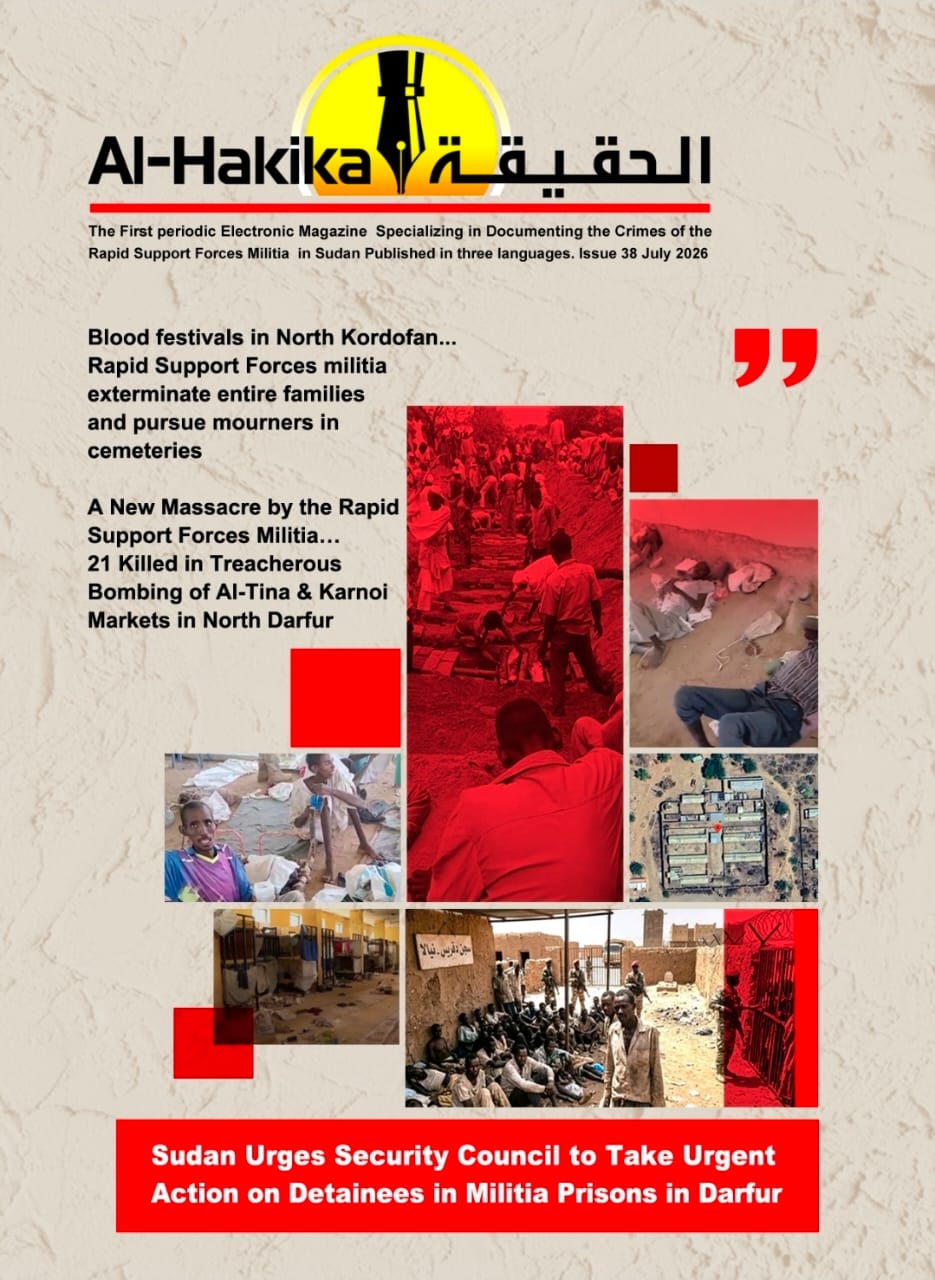
Al-Haqiqa
The first periodical electronic magazine specializing in documenting the crimes of the Rapid Support Forces militia – Issue 38 – July 2026.
Introduction
Crimes against humanity cannot be subject to any statute of limitations, nor can any machine of falsification conceal the blood of innocents that waters the land of Sudan.
Issue 38 of the periodical electronic magazine “Al-Haqiqa” is now available, continuing its sacred mission as the premier platform for documenting the crimes of the rebel Rapid Support Forces militia. In three languages (Arabic, English, and French), it presents firsthand accounts, compelling statistics, and international reports that place the international community and UN organizations before their historical, legal, and moral responsibilities.
In this issue, we delve into files steeped in blood and tears, and document dangerous shifts during the war imposed on the Sudanese people:
• North Kordofan and Darfur: Bloodshed that never ceases: We provide irrefutable evidence of the “festivals of blood” in North Kordofan, where militias not only exterminated entire families but also pursued the dead and their mourners to their graves with unprecedented brutality. This coincided with new massacres that claimed the lives of civilians in the markets of Al-Tina and Karnoi in North Darfur.
The Roots of Transnational Terrorism:
We reveal UN and intelligence reports exposing the influx of Colombian mercenaries through the Abu Dhabi station, along with the detection of advanced Chinese drones in Nyala. This provides irrefutable evidence of the militia’s external military supply lines, prompting the Attorney General to demand an immediate halt to this Emirati support and leading the Sudanese government to urge the Security Council to take immediate action to rescue those detained in militia prisons in Darfur.
▪️ Weapon of Sexual Violence and Remote Death:
This issue examines the human rights abuses suffered by displaced women from El Fasher who fled to Tawila, including the rape of minors and epilepsy patients. It also includes an analytical look at the “drone war,” which has become a tool for indiscriminate, remote killing of unarmed civilians.
The Ongoing Tragedy of Displacement:
We present to you the shocking statistics from the International Organization for Migration (IOM) regarding the displacement of 60,000 newly displaced people in Blue Nile State, facing the harsh realities of life in the open.
But from the depths of this suffering, a glimmer of hope emerges.
This issue marks a strategic turning point; the number of displaced people in Sudan has decreased by 24% thanks to the widespread return of citizens to areas recaptured and brought under the control of the Sudanese army. The army also succeeded in breaking the siege of the historic city of Dilling, restoring vital services to South Kordofan and causing prices to plummet to record lows after a prolonged period of hardship.
Al-Haqiqa magazine, in presenting this issue, supported by figures, statistics, and international reports, to international human rights mechanisms, reaffirms its commitment to remain vigilant and persistent until international justice is served and the perpetrators and their supporters are brought to justice.
Here the crime is documented… and here the truth is forged:
Al-Haqiqa documented
Blood festivals in North Kordofan… Rapid Support Forces militia exterminate entire families and pursue mourners in cemeteries
June 2026
At a time when the meanings of humanity and mercy should be manifest, the terrorist rebel Rapid Support Forces militia chose to transform the joy of Eid al-Adha and the days of sanctity into open mourning and horrific shocks through a series of systematic bloody massacres and brutal attacks with suicide drones, targeting unarmed civilians in North Kordofan State, in flagrant violation of all international humanitarian norms and laws.
The Great Bara Massacre… Treachery targeting the defenseless and mass liquidation:
The militia’s treacherous hand extended to target villages and areas in the “Greater Bara Locality,” exploiting the complete absence of any military presence or targets in these areas. Militia elements stormed the villages of the “Al-Murra” area (west of Bara), Hilla Hamid, Shaq Al-Noum, Umm Kridim, and Umm Saadoun. They began carrying out direct extrajudicial killings of civilians.
Casualty Toll:
The number of martyrs in the Al-Marra area alone rose to 58 after the bodies of 27 martyrs were found in the Azhaf area. These were among those missing from the Dar Hamid massacre, and they join the 27 civilians who were killed on the second day of Eid.
Accompanying Crimes:
The militia did not stop at killing; they also carried out widespread looting and pillaging of property, vehicles, and livestock, and deliberately burned houses to force residents to flee. They also arrested and forcibly disappeared dozens of people.
Al-Ubayyid Bleeds… Suicide Drones Pursue the Living and Mourners in Cemeteries:
The state capital, Al-Ubayyid, was not spared the militia’s malice. They launched a treacherous attack with suicide drones targeting densely populated residential neighborhoods, resulting in the martyrdom of at least 16 citizens and seriously injuring dozens more.
Extermination of Families and Terrorization of the Dead:
Medical and civilian sources documented the martyrdom of entire families, including sisters Mawada and Ikhlas al-Tijani Fadil (one of whom was pregnant) and their nephew, father Ahmed Issa Saeed and his two sons (Mutasim and al-Nour), and nine-year-old Mu’taman al-Tahir.
In an unprecedented act of depravity, militia marches shelled the Dalil cemetery during the funeral procession of previous victims, resulting in the martyrdom of four mourners and injuries to seven others, in an attempt to prevent families from burying their martyrs.
Official and Human Rights Outrage:
Calls to Designate the Rapid Support Forces as a Terrorist Organization:
These atrocities sparked widespread condemnation from state institutions and human rights organizations. The Minister of Information, Culture, Antiquities, and Tourism, Professor Khalid al-Aysar, condemned the systematic and bloody practices of the mercenary militia in Greater Bara and praised the steadfastness and sacrifices of the citizens in confronting them, affirming the unwavering support of the state and the people for the armed forces in the “Battle of Dignity.”
Ministry of Foreign Affairs and International Cooperation:
The Sudanese Ministry of Foreign Affairs held the Rapid Support Forces (RSF) militia and its regional and international backers (especially those providing funding and logistical support) fully responsible. It reiterated its call to the international community and the Security Council to officially designate the RSF as a terrorist organization due to the war crimes and crimes against humanity it has committed.
Sudan Doctors Network:
The Sudan Doctors Network warned that these systematic attacks are forcing thousands of families into displacement and homelessness amidst the catastrophic humanitarian and health conditions plaguing the country.
Legal Classification:
The National Human Rights Mechanism affirmed that the RSF militia’s actions—including mass killings, intimidation, looting, destruction of already scarce infrastructure, and disruption of livelihoods—constitute a flagrant violation of Article 17 of Additional Protocol II to the Geneva Conventions, which prohibits forced displacement, and Rule 52 of customary international law, which prohibits pillage and looting.
The mechanism emphasized that these crimes fall under the jurisdiction of the International Criminal Court (Rome Statute) as war crimes and crimes against humanity. It affirmed that individual criminal responsibility will not be limited to those who carried out the acts on the ground but will extend to the leaders and commanders who planned and were aware of these violations. It stressed that their prosecution would continue sooner or later, and that the victims’ rights will not be subject to any statute of limitations.
Al-Haqiqa Documents
UN Organization Reveals… Colombian Mercenaries via Abu Dhabi to Support the Rapid Support Forces in the Sudanese War:
In June 2026, a recent and extensive report issued by Human Rights Watch, titled “From Bogota to El Fasher,” revealed the involvement of a UAE-based security network in recruiting hundreds of private military contractors (mercenaries) from Colombia and deploying them to fight alongside the Rapid Support Forces against the Sudanese army. This reinforces international evidence of direct Emirati involvement in fueling the armed conflict and committing war crimes.
Key facts documented in the report…Recruitment tool:
A private security company in Abu Dhabi called the “Global Security Services Group” (established by officials close to the UAE government) has been recruiting hundreds of Colombian fighters since 2024.
Route and military bases:
The Colombian fighters crossed through official military facilities and bases within the UAE (such as the Ghayathi and Al Wathba bases in Abu Dhabi) to receive training and bypass official immigration procedures without having their passports stamped.
Involvement in the Battle of El Fasher:
The report confirmed the presence of these foreign contractors in El Fasher (the capital of North Darfur) during its fall in late 2025, a period marked by mass atrocities that the United Nations described as bearing “the hallmarks of genocide.”
Weapons leakage:
Colombian fighters were found in possession of ammunition and mortar rounds (81mm Bulgarian-made) that were taken directly from UAE Armed Forces stockpiles, in clear violation of end-user agreements.
Training Child Soldiers:
The report documented Colombian trainers establishing training camps for the Rapid Support Forces (RSF) around Nyala, South Darfur. These camps included the training of underage child soldiers, a practice that constitutes war crimes.
Background on the Implicated Company and Political Ties:
The Global Security Services Group (GSGS) has close ties to the UAE government. It was founded by Ahmed Mohammed Al-Humairi (former Secretary-General of the UAE Presidential Council, overseen by Sheikh Mansour bin Zayed), and shares were later transferred to his partner, Mohammed Hamdan Al-Zaabi. The company is the primary provider of armed security to UAE government ministries, making it highly unlikely that authorities were unaware of its activities, given the centralized and highly controlled nature of the UAE state.
Required Positions and Actions… Mausi Segun (Africa Director, Human Rights Watch): “The recruitment of Colombian mercenaries provides further damning evidence of UAE military support for the Rapid Support Forces, which are committing horrific atrocities. The international community must stop accepting the UAE’s blanket denials, which contradict the facts on the ground.” The UN Security Council’s urgent report recommendations:
The Panel of Experts on Sudan should be tasked with immediately investigating the International Security Services Group and its officials for violating the arms embargo imposed on Darfur since 2004.
International sanctions:
Targeted sanctions should be imposed by the European Union, the African Union, and relevant governments against implicated Emirati individuals and entities.
Arms embargo on the UAE:
All arms sales and military cooperation with the UAE should be suspended, and diplomatic pressure should be exerted to sever all supply and personnel lines to the Rapid Support Forces in Sudan.
Al-Haqiqa Documents
Drone Warfare in Sudan:
A Remote Killing Mechanism and a War of Extermination Against Unarmed Civilians
Drones in the Sudanese war are no longer merely military weapons for striking field targets. Instead, thanks to the Rapid Support Forces (Janjaweed) militia, they have become instruments of terror and indiscriminate death, targeting the very heart of civilian life.
This terrifying escalation in “drone warfare” has made unarmed Sudanese citizens the primary target, amidst international silence that is countered by UN documentation exposing the scale of the catastrophe.
1,000 Killed in 5 Months: A UN Alarm Bell
The UN High Commissioner for Human Rights, Volker Türk, expressed his strong condemnation of the “sharp and frenzied increase” in the use of drones. According to documentation from the UN Human Rights Office, these treacherous attacks claimed the lives of more than 1,000 civilians between January and May 2026 alone.
These alarming figures confirm that the militias have become the most prominent feature of this war, which erupted in April 2023, coinciding with horrific violations documented by Turk, including widespread rape and systematic sexual violence.
The “White Nile” Massacre:
Exterminating Families and Targeting the Dead and Mourners:
On June 10 and 11, 2026, the city of El Obeid witnessed a horrific massacre perpetrated by UAE-backed militias. Shells rained down on civilians, resulting in dozens of martyrs and wounds, a bitter toll that resonated in every home.
Continuing this same destructive plan targeting infrastructure and civilian sites in the states of Kordofan and White Nile, the militias launched a treacherous air attack on the strategically located city of Tendelti, which connects the El Obeid and Kosti roads, on June 11, 2026. The attack directly targeted a fuel station, destroying it and killing at least one of its employees, in a clear attempt to disrupt vital supply lines, paralyze the movement of citizens, and exacerbate civilian suffering through economic and social starvation.
The precise targeting of homes, fuel stations, and even funeral processions by drones proves beyond any doubt that we are facing a deliberate and well-funded strategy aimed at the extermination and displacement of the Sudanese people and the destruction of their daily lives.
Al-Haqiqa Documents
IOM: 60,000 Newly Displaced in Blue Nile, Most Living in the Open:
June 2026
The International Organization for Migration (IOM), a UN agency, stated in its latest statistics that 72% of the newly displaced people in the Blue Nile region of southeastern Sudan are living in informal settlements and open areas, bringing their total number to nearly 60,000.
The organization stated in a report that “72% of newly displaced individuals in Blue Nile State have sought refuge in informal settlements, while others are staying with host families or being accommodated in schools and other public buildings.”
It noted that the number of newly displaced people in Blue Nile who have fled their homes since the escalation of the conflict last January has risen to 59,742 individuals, representing 11,956 families.
Those residing in informal settlements lack protection and access to water sources and healthcare facilities, exposing women and girls to the risks of gender-based violence and exploitation, especially since they constitute 53% of the displaced population.
The organization explained that the newly displaced people were distributed across seven localities in Blue Nile State, with Damazin hosting the largest number at 31,035, followed by Baw with 15,917, Qaysan with 6,335, Al-Rusayris with 4,935, Al-Tadamun with 985, Wad Al-Mahi with 400, and Al-Karmak with 135.
The report stated that 57% of the displaced moved to rural areas within the state, while 43% settled in urban areas, mostly in Damazin and Al-Rusayris. (Note: The urban percentage was corrected to 43% instead of 44% to mathematically complement the rural percentage of 57% mentioned in the same report, bringing the total to 100%).
The Blue Nile region is hosting 371,148 internally displaced persons (IDPs), with the largest concentration of those who have fled to Damazin. It has also received 210,982 returnees, including 161,179 who returned from outside Sudan.
The report stated that women and girls constitute 53% of the newly displaced in Blue Nile, while 24% are between 6 and 17 years old, 53% are between 18 and 59 years old, and 12% are children under six.
Al-Haqiqa Documents
Rape of Minors and Epilepsy Patients:
Horrific Sexual Violence Haunts Displaced Women from El Fasher Fleeing to Tawila:
North Darfur | June 2026
Women and girls fleeing the horrors of the Rapid Support Forces (RSF) militia in El Fasher are facing a new and horrific chapter of abuses. Displacement camps in Tawila locality, North Darfur, have become scenes of systematic rape and sexual violence, amid warnings of a humanitarian and psychological catastrophe that will overwhelm the capacity of local organizations to respond.
“A Horrifying Toll and Minor Victims”:
According to documented medical and field reports obtained by community protection networks and published by the Darfur 24 platform, more than 15 confirmed cases of rape were recorded during May and June 2026 in displacement camps in Tawila (controlled by the RSF).
The published data revealed shocking details about the nature of the crimes:
▪️ Targeting Vulnerable Groups:
The attacks included new cases include underage girls, in addition to a brutal assault on a woman suffering from epilepsy.
▪️Attacks in shelters and displacement camps:
Three rapes of women were recorded while they were attempting to return to El Fasher, while the remaining crimes occurred within residential areas and displacement camps.
▪️ The hidden iceberg:
Civil protection activists confirmed that the reported numbers do not accurately reflect reality, as dozens of families refrain from reporting attacks due to fear of social stigma and persecution.
▪️ Geography of violations:
Tawila South in the eye of the storm:
The documented crimes were concentrated mainly in the Tawila South area, specifically in displacement hotspots in the following areas:
(Al-Umda, Dali, Arqo, and Dabba Nayra Al-Jadeeda)
The victims in these areas live in a tragic situation with no personal security and no mechanisms for accountability or deterrence against the perpetrators.
▪️ International condemnation and inaction A terrifying humanitarian crisis:
In the same vein, a recent report issued by a human rights organization partnered with UNICEF confirmed the documentation of 12 new cases of rape of girls, some of whom are minors, in the same region, placing the international community squarely before its direct responsibilities.
For their part, psychological and social workers in the field issued a critical plea, emphasizing that:
▪️Humanitarian services are virtually nonexistent, and the amount of medical and food aid provided is extremely limited and does not cover even the most basic needs. The paralysis of psychological support centers and the scarcity of rehabilitation and psychological support facilities completely limit the chances of recovery for survivors of the compounded trauma they have endured.
Documenting the Truth
A New Massacre by the Rapid Support Forces Militia… 21 Killed in Treacherous Bombing of Al-Tina and Karnoi Markets in North Darfur
In a new brutal escalation against unarmed civilians, the Rapid Support Forces militia committed a bloody massacre that resulted in the killing of at least 21 civilians and the wounding of dozens more, following treacherous drone strikes directly targeting popular markets in the Al-Tina and Karnoi areas of North Darfur State.
Details of the treacherous attack:
Local sources reported that the recent militia bombing of the market in Karnoi resulted in the deaths of five civilians and serious injuries to others. The attack also caused extensive damage, destroying more than ten shops. This tragic scene is compounded by the bombing of the Al-Tina market. These terrorist attacks are part of a large-scale military operation launched by the Rapid Support Forces (RSF) militia at the beginning of this year. The RSF is attempting to seize control of the Darfur region (Al-Tina, Amro, and Karnoi) by any means necessary, following the militia’s earlier failure in March to maintain its positions in Al-Tina after being driven out by the army and joint forces.
Widespread official condemnation:
In a decisive response, the Governor of Darfur, Minni Arko Minawi, condemned the barbaric attack by the Dagalo militia, describing it as a fully-fledged crime.
The Truth Documents
Displaced Persons in Sudan Decline by 24% Amidst Widespread Returns to Areas Recaptured by the Sudanese Army:
June 15, 2026 – The International Organization for Migration (IOM) announced in a report a significant decrease in the total number of internally displaced persons (IDPs) in Sudan to 8.8 million, coinciding with a notable surge in voluntary returns home.
The new figure represents a 24% decrease compared to the peak of the displacement crisis recorded in January 2025, which at that time exceeded 11.5 million IDPs. The UN agency attributed this positive demographic shift to the accelerated return movement following the Sudanese army’s recapture of strategic states, including Khartoum, Al Jazirah, and Sennar.
Digital Indicators of Displacement and Return:
According to the Displacement Tracking Report, the current humanitarian landscape is as follows:
▪️ Total internally displaced persons: 8,805,506 individuals (distributed among 1,766,946 families).
▪️ Total returnees to their areas of origin: 4,441,570 individuals (representing 886,508 families).
Documented Causes of Displacement:
The organization has recorded 847 pivotal incidents that led to displacement since the outbreak of the war. These incidents ranged from armed confrontations and tribal clashes to forced displacement due to natural disasters such as floods and fires.
Displacement Geography:
Darfur Region at the Forefront:
The Darfur region continues to bear the brunt of the humanitarian crisis, hosting 64% of the total number of internally displaced persons in the country.
The Truth Documents
Lifeline Returns to South Kordofan: Army Breaks Siege of Dilling, Prices Plummet to Record Lows
Kadugli: June 2026
In a significant military and economic breakthrough, the cities of Kadugli and Dilling in South Kordofan State breathed a sigh of relief following a sharp and rapid drop in the prices of food and basic commodities. This relief came after the Sudanese army successfully broke the siege of Dilling and secured supply lines, ending months of isolation and severe humanitarian suffering.
Military Victory Opens the Road to Kadugli:
The armed forces managed to end the siege of Dilling, the second largest city in the state, for the third time since the beginning of this year. This came after fierce battles waged by the Sudanese army against the Rapid Support Forces and the Sudan People’s Liberation Movement-North (SPLM-N) faction led by Abdel Aziz al-Hilu, culminating in the complete capture of the strategic town of Al-Tukma (7 kilometers east of Dilling). This paves the way for securing the national highway and ending the imposed isolation of the capital, Kadugli.
Convoys Break Months of Isolation:
According to Sudan Tribune, local sources and eyewitnesses reported that the capital, Kadugli, received a massive convoy of approximately 12 trucks loaded with food and life-saving medicines. This is the first large-scale aid shipment to reach the city since last January. The convoy, which arrived under heavy military escort, was met with a massive popular welcome from citizens who had suffered from severe shortages for the past several months.
Price Collapse and Market Recovery:
This military breakthrough was immediately reflected in market activity, which witnessed an abundance of supplies and a record drop in prices, exceeding 60% for some basic commodities, according to local traders.
Al-Haqiqa Documents
Sudan Urges Security Council to Take Urgent Action on Detainees in Militia Prisons in Darfur:
New York – June 12, 2026 – The Permanent Mission of Sudan to the United Nations sent a letter to the President of the Security Council, accusing the Rapid Support Forces (RSF) militia of committing grave and systematic violations of international humanitarian law and international human rights law against civilians and prisoners of war held in prisons under its control in the Darfur region. The letter called on the international community to intervene urgently to investigate these violations and hold those responsible accountable.
Numbers and Categories of Detainees in Daqris Prison:
The letter stated that information available to the Sudanese government indicates that there are approximately 19,800 detainees and prisoners held by the militia in Daqris Prison in Nyala, South Darfur State. These detainees are distributed as follows:
▪️3,795 members of the Sudanese Armed Forces.
▪️5,000 civilians from El Fasher.
▪️ 4,270 police officers.
▪️ 544 members of the General Intelligence Service.
▪️73 medical personnel.
▪️ 5,434 civilians from various professions.
▪️690 women.
Catastrophic Conditions and Accusations of Serious Crimes:
The government accused the militia of systematic torture, ill-treatment, and denial of medical care and food. It stated that the prison’s humanitarian and health conditions were “catastrophic,” and that many detainees suffering from chronic illnesses had died due to medical neglect. Furthermore, the sick was prevented from receiving specialized treatment outside the prison or from contacting their families.
The letter also included serious accusations of organized human organ trafficking within the Daqris prison. Reports indicated that foreign medical personnel affiliated with the militia were involved in harvesting organs from some detainees and transporting them to foreign entities operating in Nyala. The victims were then buried at sites belonging to the 16th Infantry Division to conceal evidence.
The Situation at Shala Prison in El Fasher:
Regarding Shala Prison, west of El Fasher, the letter reported that approximately 881 military prisoners and 407 civilian detainees (including 113 children under the age of 18) were being held by the militia.
Mortality and Epidemic Indicators:
The letter confirmed that many detainees suffer from injuries and chronic illnesses without receiving necessary medical care. This has led to the deaths of approximately 300 injured detainees in the past two months due to untreated wounds and lack of healthcare, in addition to a cholera outbreak within the prison since last February.
Al-Haqiqa Documents
Sudan Before the Human Rights Council… The Attorney General Reveals a Horrifying Toll of Militia Violations and Demands an Immediate Halt to Emirati Support:
Al-Haqiqa – Geneva
June 14, 2026
In a powerful speech accompanied by shocking figures, the Attorney General of the Republic of Sudan and Head of the National Commission of Inquiry, Ms. Intisar Ahmed Abdel Aal, placed the international community before its historical and legal responsibilities. This came during her address to the United Nations Human Rights Council in Geneva,
where she presented the fifth progress report of the National Commission on crimes and violations of national and international humanitarian law.
National Sovereignty and a Firm Principled Stance
The Attorney General affirmed that the National Committee’s participation in the Council’s work stems from Sudan’s commitment to keeping international mechanisms informed of national efforts to provide redress for victims, achieve justice, and prevent impunity. She emphasized that this step in no way affects Sudan’s principled stance rejecting the International Commission of Inquiry or the resolution establishing it.
Documenting War Crimes and Genocide
Abdel-Aal explained that the Committee, operating with complete independence, has documented brutal and systematic patterns of crimes committed by the rebel militia against civilians and infrastructure, confirming that these violations amount to:
▪️ War crimes.
▪️Crimes against humanity.
▪️The crime of genocide.
The documented atrocities included ethnic targeting, murder, forced displacement, rape, and the abduction of civilians, along with horrific abuses within militia detention centers, particularly Shalla Prison in El Fasher and Daqris Prison in Nyala.
In Numbers: The Sudanese Judiciary Confronts Militia Terrorism
The Attorney General revealed unprecedented criminal statistics reflecting the scale of the disaster and the efforts of the judicial authorities:
▪️ 149,860 criminal cases registered as a total.
▪️ 385 cases against members of the security forces (whose immunities were lifted in the interest of transparency).
▪️21,787 cases in which investigations have been completed and referred to national courts.
▪️ 10,417 cases that have been adjudicated and judgments issued to date.
The Human and Economic Toll of the War
As for the human and material losses resulting from the militia’s aggression, they have reached horrifying figures:
▪️ 30,971 documented killings.
▪️ 44,617 wounded and injured.
▪️ 14,999 cases of detention and enforced disappearance.
▪️2,200 cases of rape and sexual assault.
▪️ $771 billion: Initial estimates of the economic losses resulting from the destruction of infrastructure.
A direct confrontation with the international community… The UAE, a sponsor of the war:
In the strongest diplomatic tone, the Attorney General asserted that “stopping external support for the rebel militia is the essential lever for ending the war and alleviating the suffering of civilians.”
Abdel-Aal called on the international community to adopt and support the Sudanese government’s initiative to end the war and to implement the principle of complementarity in supporting the national judiciary. She directly and explicitly demanded:
▪️”Decisive international action to stop external support for the rebel militia by its main sponsor, the United Arab Emirates, to dry up its sources of funding, and to prevent the transfer and recruitment of foreign mercenaries into Sudanese territory.”
